Action Comics #484, art by Jose Luis Garcia-Lopez and Dick Giordano
There’s a certain bait-and-switch that happens with comic books. Quite often, the cover doesn’t match the contents of the interior. This one was no exception, although the marriage of Superman and Lois Lane does take place within. It’s just that it was the Superman and Lois Lane of Earth-2, the world of the golden age of comics instead of the continuity of the Superman of 1978. And while the outstanding image drawn by Jose Luis Garcia-Lopez sold this comic, the interiors were drawn by Curt Swan, the stalwart Superman artist whose work spanned decades. There is nothing wrong with Curt Swan’s artwork. It’s like comfort food to me. But the dynamism of Garcia-Lopez and just the pure joy expressed on his subjects’ faces always sold me on a comic book. I hoped that one day he would succeed Curt Swan as the regular Superman artist. And then, the very next week, I practically got my wish.
DC Comics Presents #1, art by Jose Luis Garcia-Lopez and Dan Adkins
On the stands was a new title, DC Comics Presents, sort of a companion title to Brave and the Bold, which had been a Batman team-up book for several years at that point. I loved these sorts of team-ups. If I didn’t know anything about The Unknown Soldier, for example, I could learn about him when he teamed up with Batman in B&B. Outside of actual story, it was a way for DC to maintain their trademarks on dormant characters. DC Comics Presents was Superman’s own team-up book. I’m sure they were gearing up for the upcoming Superman movie that people were talking about. There had already been casting rumors flying about in trade magazines, with names like Robert Redford and Sylvester Stallone in the running. But Starlog Magazine #11, earlier in the year, had a photograph of the new Superman, Christopher Reeve!
Unlike the previous week’s Action Comics #484, DC Comics presents had Jose Luiz Garcia-Lopez art throughout the entire book. And it was gorgeous. It was kind of a silly story written by Martin Pasko, featuring a race across time between Superman and The Flash, who had been drawn into a civil war between aliens, but I loved it anyway. As it turned out, years later, I found out from Marty himself that it was not his favorite story. He and I became Facebook friends and had many interactions. My favorite came on his birthday one year:
“Okay, Marty. I’m going to tell you the same thing I told Elliot S Maggin when I met him a few years ago. And it’s the same thing I told Dennis O’Neil when I met him a few years before that:
“I grew up being beaten every day from age seven until age 12, when my mother allowed me to go live with my father, for fear that her new husband was going to beat me to death. The worst thing he did to me was not the beatings, but burning my comic books in front of me, simply as an act of cruelty. My father was not an abuser, but he was also not a very good example to follow. It was his cheating that led to their divorce and my subsequent abuse. But at least he let me (and encouraged me) to read comics. I didn’t have adult male role models in my life. At least not any in the real world. The men who provided that example for me were Batman and Superman. And those heroes were written by real human beings whose names I knew, and you were most certainly one of them. From various issues of Action, up to and including #500 (one of my personal favorites), to DC Comics Presents #1 to various issues of JLA and World’s Finest, you did your fair share of shaping my life going into manhood. I still believe in the values those characters once embodied to this day.
“I’m 53 now, a middle school teacher for the past 31 years. I help shape the lives of young people. I also create comics, and not in the modern sense that we see Batman and Superman now, written for adults. My comics are written for me at age 12 and 13. They’re written for kids who need them, like I needed you guys.
“My 12-year-old daughter reads comics now too, and she also knows your work from Batman: Mask of the Phantasm. At the risk of turning you into the monster you fear, I wanted you to know just how much your comics meant to me as a child, an adult, a teacher, and a father. I don’t know if I’ll get the chance to meet you face-to-face one day, but I wanted you to know all of this before you got another year older.
“Thank you and happy birthday.”
To which he replied, “I’m literally speechless (yes, that’s a joke from Mr. Motormouth, moi). But, honestly and sincerely, Jim McClain: Your deeply moving and beautifully articulated comment is the greatest compliment I’ve ever been paid.”
Marty died not long after that exchange, and I am so very grateful that I had the chance to tell him what his writing meant to me. They say, never meet your heroes, but I think in this case it was one of the highlights of my life.
I also happen to be Facebook friends with Jose Luis Garcia-Lopez. But him, I’ve met in person. I was so looking forward to reading more of the DC Comics Presents series just to see his Superman in every issue, but again, the distribution in my small hometown of Mesic left a lot to be desired, and I never saw another issue of DCP until #26, a couple of years later. I never even got to read the second part of the story that it opened with until I was in college. I admire the Maestro, as he’s sometimes called. He defined what DC characters looked like for an entire generation. You may not know his name, but you know his art.
The 1982 DC Comics Style Guide
1984 Super Powers Action FigureDC Heroes Roleplaying Game
I liked to help out my grandparents whenever I could. My grandpa had just turned 68 at the end of January and my grandma turned 64 on Christmas Eve of 1977. That was one of the funny things about my Grandma McClain. She had a December birthday, like me, and knew what it was like to get those combination gifts. Some of you know, I’m sure: “This is for your birthday and Christmas both.” She always made sure that I received separate gifts and cards for my birthday, and she always made me a cake after I went to live with my dad. You know, looking back on it now, it only happened six times before I was off to college, but I appreciated that chocolate cake with chocolate frosting every time.
My grandpa installed a woodstove in the dining room of their small house in Mesick. It was the 70s, you know, and that meant the energy crisis. The cost of oil was skyrocketing, and that included heating oil. My grandparents had a heating oil tank outside the kitchen window that powered the furnace in the winter and it was getting expensive. My grandpa bought wood by the cord and it was stacked up outside the back door, which led to the mud room. Whenever the woodbox in the mudroom got low, they had me come over and split wood. Yes, with an axe, just like a lumberjack. I would spend an hour or so out on the back patio, gradually de-layering from my winter coat to a down vest, down to a flannel shirt as I chopped. I could work up a pretty good sweat, even in the winter. I’d switch from chopping right-handed to left-handed to work out different muscles and avoid getting too sore. I’d been chopping wood since I was 12, and I knew a few tricks. When I was done, my grandpa would slip me a dollar without my dad knowing. My dad would have really been upset if he’d known Grandpa was paying me anything. They were already helping us out while my dad was out of work. I would take the money, though, and buy comic books or trading cards and the occasional candy bar.
I bought one of my favorite comics ever with one of those dollars. It was Superboy and the Legion of Super-Heroes #239.
Superboy #239, cover by Mike Grell and Josef Rubinstein
I loved the Legion books because they were teenagers, just like me. Well, they were probably a little older since I’d been a teenager for two whole months, but you get the point. It had a science fiction bent, being set in the 30th century, always 1000 years ahead of our time. So, this one would have been set in 2978 instead of 1978. I always thought it was funny that it wasn’t 1000 years ahead of Superboy’s time. It was 1000 years ahead of Superman‘s (our) time. In the best way, the Legion stories were kind of like Star Trek and superheroes combined.
This particular comic starred my favorite Legionnaire, Ultra Boy. As I wrote here, I like Ultra Boy because he could only use his ultrapowers one at a time. He could be strong or invulnerable or fast. He could fly or use his penetra-vision (like X-Ray vision but he could see through lead, too) or his flash vision (think heat vision), but only one at a time. He was limited, and had to be smart about it. There’s an entire power framework in the superhero RPG Champions built around this concept. The power slots are labeled “ultra” slots with good reason!
In the comic, Ultra Boy wakes up in a crashed space ship without his flight ring and no memory of how he got there. In fact, he’s not even sure on which planet or moon he is. As he slowly figures things out, he gets sold out by a former flame, who is then immediately murdered by a weapon that mimics Ultra Boy’s flash vision. Jo (Ultra Boy’s real name) quickly discovers that he’s being hunted on his home planet of Rimbor, and not by just anyone, but the Legion itself, his own teammates. He’s been framed for murder! Ultra Boy leads them on a merry chase, using his knowledge about his friends to keep things to his advantage. Ultra Boy uses his strength to defeat Star Boy, who had pinned Ultra Boy with his gravity powers, then takes his flight ring so he can fly and use one of his other powers at the same time. He even manages to outmaneuver Superboy and Mon-El so that they crash into each other at superspeed, stunning both. But eventually, Colossal Boy sucker punches Ultra Boy from around a corner, and Superboy and Mon-El combine to knock him out with a timed simultaneous punch. When Ultra Boy comes to, he’s about to be turned over to the authorities, when Chamelon Boy shows up to clear his name, using good old-fashioned detective work, which he was doing while the rest of the Legionnaires were busy fighting.
This is still one of my favorite issues of all time. It has great artwork by Jim Starlin, inked by Joe Rubinstein, with finished dialogue by Paul Levitz.
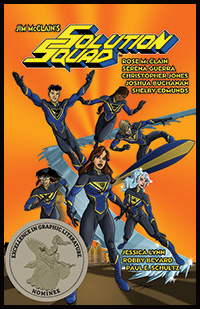
I love it so much that when I wrote an illustrated prose Solution Squad story for my graphic novel, I had a cover drawn by my friends Paul Schultz and Shelby Edmunds that is reminiscent of the cover of this book.
Cover of The Last Boy, by Paul Schultz and Shelby Edmunds
Looking back, much of my Solution Squad graphic novel was informed by these influential comics of my adolescence. And I wouldn’t have it any other way.
It’s hard to believe that 10 years have passed since the first time I set up as an artist at C2E2. It felt like a big gamble to even see if I could get in, but I did. The timing was so incredibly tight, but it all worked out in the end. The Solution Squad print comics had just come in two weeks earlier, and I felt like I was juggling a lot. I had applied for Solution Squad to be a part of the first open-invitation round of ComiXology’s Submit program, and again, to my astonishment, it was accepted! The online comic went live on April 24, just two days before the convention. It felt like everything was falling into place.
Using our contact at Rink Printing in South Bend, who had printed our comics, we had prints made up of Jordan’s final character designs, as well as professional business cards. I borrowed a display rack from our local comic shop, bought a navy blue tablecloth with criss-cross square patterns on it, like graph paper, and off we went. How many comics should I bring with me? I had no idea, so I just brought them all. They were still in the back of the minivan.
I have to admit, we were nervous when the morning started. The table was expensive, $425, which was not a small investment. Not a lot of interest or people stopping by. Jordan and I were just kind of soaking in the atmosphere of the place. C2E2, even in 2013 was a huge convention, with easily 50,000 people in the convention hall over the three days. Jordan got a few commissions, but I was getting more and more nervous by the minute. I was scheduled to speak at a panel at 12:45, moderated by Josh Elder, of the non-profit Reading With Pictures. I had met Josh the previous summer as he spoke at the Kids Read Comics event in Ann Arbor, Michigan, and he seemed very happy to meet an actual teacher interested in making educational comics. So, he invited me to be on the panel with him and Dr. Carol Tilley, the leading expert on Fredric Wertham, author of Seduction of the Innocent, and just a general expert in comics reading history, period. Just before 12:45, I grabbed my dress shirt and my favorite Batman tie, loaded up my laptop, and headed to the nearest restroom to change.
Josh Elder, Carol Tilley, and me at our panel, “Comics and the Common Core State Standards”
To my utter amazement, when I got there, the room was packed. There were easily more than 200 people in the room, maybe closer to 300. I had never spoken in front of that many people before, let alone teachers and professionals. I have to say, I was nervous about how a comic book teaching math would be perceived by actual teachers.
Josh opened the program, talking about how comics had helped him to learn to read as a child. He always cites Transformers #4 as the specific issue. And his tagline of “Hooked on comics worked for me” always gets a chuckle. That gave me a natural segue going into my part of the presentation because my hook into reading was Superboy #165, from…a few years before Josh’s comic. I started my presentation with a very bland, but effective opening slide:
My opening slide. Always good for a laugh from teachers!
As a teacher who had had far too many Power Points read to me in my career, I knew this would get a laugh, and it did. There was even a smattering of applause. I immediately went from near-shaking to relaxed. As I went through each slide, I introduced the audience to the characters I created and explained how I used them in class to introduce and teach math concepts. There were lots of murmurs from the crowd, and laughs exactly where I hoped they would land. And when I closed with the final slide, explaining that the Squad flew around in the Coordinate Plane, I thought the place was going to fall apart. There was raucous laughter; thunderous applause. And I got goosebumps. What just happened?
Still makes people laugh!
I listened to Carol’s presentation, and I never fail to learn something from her. But I was feeling just a rush of energy that made it hard to concentrate. After the whole panel ended, I was absolutely mobbed. People rushed up to shake my hand and tell me what a great thing Solution Squad was. One teacher said, “This is the most creative thing I’ve ever seen a teacher do!” and that nearly brought me to tears. Jordan, who was at the panel, escaped to get down to the convention table. They could read the writing on the wall. And when they got to the table, there was aleady a crowd. Talk about effective marketing! We had been sitting virtually alone for two hours on the first day of the convention and now we were swamped. After 20 minutes, I finally got back to the table myself, where there was a line of people waiting to talk to me.
One of the people waiting to talk to me was young fourth-year Chicago teacher Amy Hopkins, who bought an entire class set of 30 comics from me. Amy used Solution Squad in her class and even had her students write letters to me about how much they enjoyed the comic. Amy and I have been good friends ever since.
I made another friend that day in Bob Cassinelli, who worked at Gail Borden Public Library in Elgin Illinois. Bob invited Jordan and me to appear at his comic book show, Comic Book Mania, which we were pleased to do. I set up at that show for years afterward.
And I can never forget Bruce Nelson. Bruce was a teacher in Indianapolis who specialized in STEM education. Bruce told me about the Lilly Endowment Teacher Creativity Fellowship, a $10,000 fellowship for Indiana teachers that would allow me to fund my creative pursuits for a summer project. He told me all about how to apply. I did, and I won one of the 100 Fellowships. Less than a year later, I had a check for $10,000 in my hand. I guess the $425 convention table paid off!
After this convention and specifically my panel appearance, Josh Elder invited me to work with him and Reading With Pictures more closely as they tried to complete their work on The Graphic Textbook. I was brought in as a math consultant first, to work with de facto editor Tracy Edmunds, who became yet another good friend, then as a letterer for some of the anthology’s stories, and even an uncredited assistant editor of sorts, making corrections to some of the art in the book. I ended up designing the Teachers Guide using my very limited skills in InDesign, and co-editing that book along with Tracy Edmunds. Thanks to a shift in the Common Core State Standards, which moved prime numbers from a sixth grade standard down to a fourth grade standard, I was asked if my Solution Squad story could be included in the book, which I immediately agreed to. Later, this book would be bought by Andrews McMeel and published as Reading With Pictures: Comics That Make Kids Smarter, which got me my own author entry in the Library of Congress.
This one fateful event changed my life in myriad ways, leading to many more panel and convention appearances, inspiring me to travel all over the country talking about comics and education, making friends and earning accolades as I went. My life in comics was a cascade of new experiences, friendships, and uncountable rewards.
All told, we sold 83 copies of Solution Squad #1 that weekend, and even though those were respectable numbers for an unknown comic book about math heroes, I still remember posting on social media, “I feel like I’ve caught lightning in a bottle.” It was one of the best feelings of my entire life.
The entire idea of collecting comic books for monetary value was foreign to most kids in 1978. They were cheap reading material. But the appeal of the recent #1 issues from DC Comics, Firestorm and Steel the Indestructible Man was hard to pass up. So, when a #100 issue found its way to the stands, it was also a rare day, because most of the popular comics of the time from DC were in the three hundreds or even four hundreds. That’s not why I bought Showcase #100.
Showcase #100, art by Joe Staton
Showcase #100 got my attention because of the sheer number of characters on the front cover. I didn’t even care what the story was about, I just had to know what was going on to bring all these characters together. I knew the Flash, Green Lantern, Aquaman, the Atom, and Adam Strange from Justice League of America, and I knew the Spectre from various JLA/JSA crossovers and teaming up with Batman in Brave and the Bold. But then there was the Creeper, who I remembered from my early childhood, as well as the Hawk and the Dove! Way up there in the corner were the Metal Men. And look! Far in the back center were the Teen Titans! With this many characters, the adventure had to be serious.
The fabric of space and time seemed to be tearing as characters from every location and era seemed to be gathering at once in the same place. And then it was revealed inside that there were even more characters than depicted on the cover. Such an odd mishmash of heroes! Even the Inferior Five were involved. Well, as it happned, the Earth was being ripped from its orbit and being carried away, and it was up to this hodgepodge to fix it!
After a satisfying, though quick conclusion, everything was safe again, and it was only then that the secret of the colossal team-up was revealed. These were all characters who had either been introduced in the Showcase title, or had been revamped in Showcase! That’s when I remembered the Hawk and the Dove appeared in Showcase #75, which I had when I was very young, back when comics were just 12 cents.
Showcase #75, art by Steve Ditko
I had just gotten Showcase #94 the previous summer with the New Doom Patrol, so I kind of wondered what had happened to the title that it was only up in the 90s over ten years later. Still, I thought that was a pretty cool gimmick, and admired whoever thought of it. We didn’t use the term “meta” back then, but this was as “meta” as it got!
Ten years ago today, I took delivery of 3,000 copies of my very own comic book, Solution Squad #1. It was a labor of love. What started out as a workbook full of math problems with superhero context became a comic book story about a group of teen superheroes who powers and name were based on math concepts.
The roots of the idea date back to the very early 2000s. Superheroes adorned my classroom. Graphic novels filled my bookshelves. Bored easily with endless worksheets and activities with generic characters and names, I decided one day to spruce up my activities. I made an activity that led students to get to know their textbooks. On it, I put an image of Cyborg from the Teen Titans cartoon (popular at the time) to explain with a word balloon how students getting to know their textbook was like his getting to know his robotic body. Kids loved it. When I had to drill them on math facts (yes, we still had to do that occasionally), I used a 1982 DC Style Guide image of the Flash running across the top of the paper, calling the activities Flash Time. Because everything wasn’t searchable online yet, I stole the line art image from the DC Heroes Roleplaying Game. They loved that too. It made a generic activity more palatable! So, I started incorporating superheroes into all my activities. Instead of graphing butterflies on the coordinate plane, we graphed Superman’s pentagonal insignia while listening to recordings of his old-time radio show on my replica 1933 cathedral-style radio.
Look how bad our phone cameras were at the time!
When I had created dozens of such activities, I thought to myself it might be a pretty cool idea to make them into a book that teachers and substitutes could use. Since I never thought in a million years that DC or Marvel would let me use their characters for such a book, I decided to make my own characters. I had been making my own comic book characters for years, since I was a child. As a young adult, I had participated in superhero role-playing games, and had paid dozens of professionals to draw my RPG characters for me, establishing contacts that would become very valuable later on. I drew for myself as well, but I was never as good as I wanted to be, and I was good enough to know my own limitations. My crude drawings were good enough to get me started in making my own characters. My first was Absolutia. Absolutia can raise and lower temperature. When she raises the temperature, it serves as a model for adding positive integers. When she lowers temperature, we’re adding negative integers. The effort required to change the temperature in either direction is a great model for absolute value—hence, her code name.
Hey, we all have to start somewhere!
La Calculadora was a deliberate choice in trying to reach some of my students of Mexican ancestry. I taught in a community that has a large immigrant population, so I had learned enough rudimentary Spanish to get through some math lessons from our ESL teacher, and one of the first words I learned was la calculadora, or the calculator. I remembered The Calculator as a lame character from my childhood, but the Spanish twist on the word suggested a female character named Dora, and well, there you go. This character wouldn’t just be a weirdo in a suit. She would have a perfect memory and the ability to absorb and store knowledge at amazing rates. You see now how my brain works. From there, I replaced established DC and Marvel characters with my own.
The very earliest La Calculadora image. I hadn’t even finished designing the costumes yet.
Needing a name for my team, I found all the inspiration I needed in the pre-algebra course I was teaching.. One of the key ideas in the class was finding solutions to equations, and Solution Squad provided the appropriate comic book alliteration. I started brainstorming different characters, some of which made it to the final product, and some of which would wait until later.
One of the big ideas for which there was no comic book parallel was a set of twins code-named Abscissa and Ordinate, which are mathematical terms for the x-coordinate and y-coordinate, respectively, of an ordered pair. I knew they were going to be twins, but I hadn’t decided on ethnicity or gender yet. At this same time, my wife and I were preparing to adopt a baby girl from China. I had to prepare to be absent from school for three weeks, and as I started to put together character ideas for Solution Squad, we received our referral with the name and picture of our soon-to-be daughter. The name given to her by the orphanage was Xiao Sheng. Her name began with X! It was an omen! She would become Abscissa, and so I made up an imaginary brother for her and based their story on one I had heard during the adoption process. They would be siblings separated very young and adopted by separate American families only to be reunited later. She was born first, and he was born second. She had running speed and an independent personality, and he could fly and would always follow her lead. Together, they are The Ordered Pair!
The other characters began to fall into place, one by one. Equality is the granddaughter of an African-American civil rights pioneer. She has symmetrical features, and her names and those of her family are all palindromes. She has the ability to duplicate exactly anyone else’s ability. She is the only one of the team who actually has the build of a muscular superhero. She was a star athlete even before she got powers and she looks it. The rest of the characters have realistic body styles and differences.
Radical is my Shaggy character, my comic relief. He is a slacker and sometimes a fool. He’s also a time traveler with the most complex powers. He can generate electromagnetic prisms with bases formed around right triangles. He can then telekinetically move things along the hypotenuse side of the prism. If he pushes his power too hard, he disappears and reappears in another time. There’s no good mathematical reason for that. I had just read The Time Traveler’s Wife, and I thought it would be cool to have a character who would have an excuse for using slang. I dislike it when modern teen comic characters talk like it’s 10 or even 15 years ago. Radical has an excuse. He may have just been to the period where it was groovy to say something rad.
Early Radical, 2007
It was hard to figure out what Solution Squad was. It started as a sourcebook of activities. Then it started expanding to include complete lesson plans. But then I picked up a copy of The Manga Guide to Calculus, and I knew exactly what it had to be. It had to be the superhero comic that I always wanted to make, but with a math lesson embedded within! For the first story, I wanted something cool and fun, not something that every math teacher already knows. So, I built a deathtrap that could be escaped only by decoding a message written with a prime number code. My high school Algebra I teacher, Charles Shimek, taught me how to construct the Sieve of Eratosthenes when I was a freshman in high school. I was actually surprised to find out that some math teachers have never heard of it. Additionally, I use prime numbers and subsequently prime factorization to reduce fractions similar to the way algebraic fractions are reduced. It reinforces old skills, introduces alternate methods, and prepares students for future skills simultaneously.
As I plotted out the story, intending to draw it myself, I designed the characters, did layouts, wrote dialogue, and then started to plant seeds within the story. They would fly in the “Coordinate Plane.”
The early Coordinate Plane, inspired by the Jonny Quest plane
As you can see, I digitally added the SS logo with has a story all its own. I wanted a symbol that tessellated, and I wanted the logo to be able to be drawn on graph paper with few fractions. This took forever.
The original logo
I refined it only once, and master letterer and designer Todd Klein himself, gave it his seal of approval.
I would give them a robotic assistant made up of billions of networked nanorobots–3.92 X 10⁹ robots, in fact. He was a carryover from an old Champions campaign that I ran. His name was UNO (universal nanorobotic operative). I planted percent-change problems, distance-rate-time problems, Pythagorean Theorem problems, anything I could think of for which I already had activities. Any math teachers worth their salt can get math problems out of virtually anything. Solution Squad was going to be like a 24-page Easter egg hunt.
I knew my shortcomings as an artist, and even my attempts at finishing the looks of the characters was making me incredibly discouraged. But then, serendipitously, I saw some of my niece’s artwork from college appearing online. The amazing Rose McClain had a style that was suited much better than mine to representing young characters. I asked her what her plans were, and she said she wanted to get into comics. So, I hired her. For a long time, I couldn’t imagine the characters any other way than the way she drew them.
Rose’s first swing at a Solution Squad character, AbsolutiaAnother pass, with an early version of the costume. I inked this one, so don’t blame Rose.I started playing with colors. My school’s colors were blue and gold.I started adding piping in the ink stageOne of my followup attemptsFinal costume design with insignia to be added later
Then, with all of this drawing, and back and forth, Rose’s art skills exploded.
Final inked version by Rose with insignia drawn by me in Photoshop.
Final version in living color!
So, yes, all of this was preliminary work done well in advance of making the actual comic book. While this was going on, I was laying out the story.
This pretty much remained intact. Note the old Coordinate plane, though
While Rose began work on the actual pages in 2011, we attended Cherry Capital Con (as it was known then) up in Traverse City, Michigan. Using the designs Rose had done, I had the idea to get comic book artists famous for doing teenage or young characters to do character profiles for their origins section. I wanted to do an Official Handbook of the Marvel Universe/Who’s Who section of the comic. I didn’t want to spend time in the comic itself going over origin stories, so I wrote them in prose form. The first profile art we got was from Invincible artist Ryan Ottley.
Absolutia by Ryan Ottley
At the same time, Ryan’s tablemate, Jason Howard, who was doing Super Dinosaur at the time, was tasked to draw the Ordered Pair, Abscissa and Ordinate.
Abscissa and Ordinate, by Jason Howard
Next up was Radical, as I went to Wizard World Chicago that same summer. Carlo Barberi, who had drawn Gen13, was readily available, so I commissioned him! This is one of my favorite sketches of Radical.
Radical, by Carlo Barberi
We launched the comic as a web comic on February 29, 2012, and ran a Kickstarter to raise funds at the same time. Kickstarter was relatively young, then, and from the outside, it sure looked easy. It was not. My Kickstarter crashed and burned, raising only $535 in pledges out of a target of $7500. I determined to press on anyway, paying Rose and the other artists out of pocket by doing extra jobs after school.
Rose and I attended Cherry Capital Con that year in Artist Alley, with only a few pages of the webcomic done. We were just trying to get the word out.
Jim and Rose, Cherry Capital Con 2012
I brought activity pages, pencils with the web address, and some posters I had printed up. We had a vinyl banner held up with PVC pipe that I had fashioned into a stand. Rose got three art commissions, so her show was made!
This next story is one the highlights of my comic book-making career. By chance, I befriended George Pérez on Facebook. One of the advantages of going to comic conventions since 1984 was that I knew a lot of pros, so we had many mutual friends. Just out of the blue, I sent him a friend request and he accepted! I thought, if I was going to have anyone draw the cover of my teen hero comic, it would have to be George. I sent him a message without having any high hopes, explained what I was trying to do with math and comics, and to my surprise, he responded! He said he would have been happy to do it, but he had just signed an exclusive contract with DC Comics. BUT he would he happy to draw a pin-up! I almost fainted. I gave him the specs for La Calculadora (whose real name was not coincidentally, Pérez), and he said he would deliver it at C2E2. I was ecstatic!
When I got to C2E2, I headed directly for George’s table, with Rose and six-year-old Sera in tow. We waited an hour to get up to his table, and when we finally got to talk to him–he had forgotten the drawing at home. I was like, no big deal, and he apologized profusely, and asked for my address. He said he would send it as soon as he got home and that I could send him a check when it arrived. I thanked him, got a photo with him, and took the respectable amount of cash I had saved for this to find another artist for Equality.
George and me, 2012. Again, primitive phone cameras!
I found Jamal Igle, who was also a Facebook friend, and asked him to draw Equality. Jamal had done both Supergirl and Firestorm, young characters, and I loved his art style.
Equality, by Jamal Igle at C2E2 2012
I was super happy with that sketch. I thought it captured her natural athleticism.
It wasn’t even a week after I got home that I received the La Calculadora sketch from George.
La Calculadora by George Pérez
I was, and am, over the moon for this piece. It wasn’t long after this that George’s eyesight started failing, and he wasn’t able to do his typically high-quality work. He told me that he had drawn Dora to resemble his niece, Milla, to get a true Latina look.
Milla Vela, George’s niece
With all six profile pics done, I started shopping for a cover artist. Quite by accident, I discovered Steven E. Gordon, the character designer of X-Men Evolution. I had already started to work out an elevator pitch for Solution Squad. It was, “X-Men Evolution meets Numbers.” When I approached Steve to see if he was interested in doing the cover, he immediately said yes. I gave him Rose’s character art and asked for something quite specific.
When I was a boy, I saw my first DC Comics treasury, the Batman one with the Neal Adams cover, and I begged my mother to buy it for me. She scolded me, knowing full well what would happen to it if she bought it for me. But every time we went into a store, I could see it from a mile away. That red background could pierce fog!
Limited Collector’s Edition C-25, cover by Neal Adams
And since the Squad’s colors mimicked Batman’s own, I thought it would be natural. Steve’s son Eric Gordon did the colors.
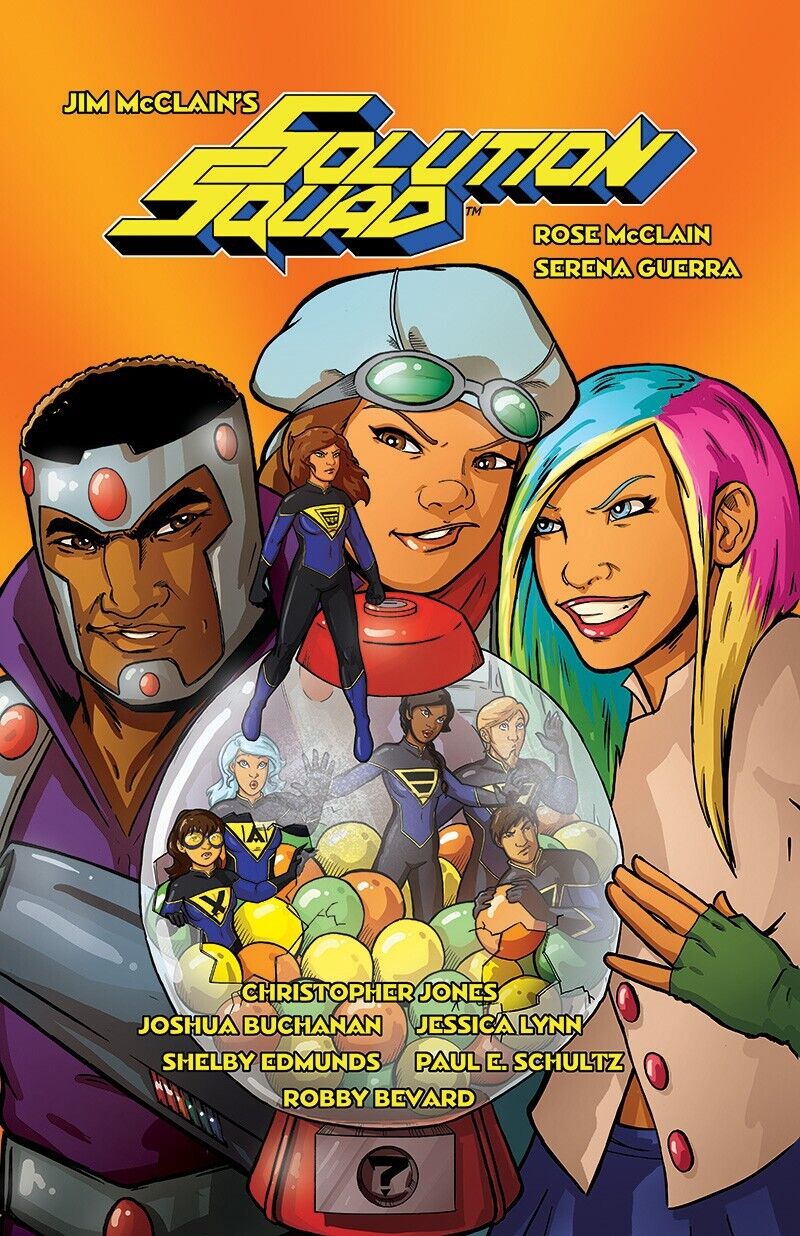
Solution Squad #1, by Steve and Eric Gordon
As you can see, I had to learn how to make a UPC symbol as well. There was no end to learning while making a comic book.
While the story of Solution Squad was 24 pages, my idea was to make a 32-page comic, so I could include the origin stories as well. And not one to pass up a gimmick, I decided to make it a flip book. One one side would be the story, and if you flipped the comic book upside down and turned it over, there would be like another comic with its own cover and all the origin stories. I wanted to draw a cover myself, so I got to it. By then, we were refining the Coordinate Plane for the comic.
Back cover, pencils by me, inks by Terry Huddleston, colors by Rose
As you can see, my artwork was improving as well, leaps and bounds beyond how I started.
By early 2013, the comic was done. I found out about a local printer, met with them, and priced my book. I had no idea how many to print, but the best price break came with offset printing at 3,000 copies. Each copy would cost 85 cents. That seemed pretty good for offset printing in full color and a cover price of $3.99.
And on April 12, they were delivered. Ever see what 3,000 comics looks like?
3,000 copies of Solution Squad #1
Thanks for going on this journey with me. It was fun putting that story together. There will be another one coming soon when Rose and I hit C2E2 for the first time as pros! Until then!
Hot on the heels of the great treasury-size All-New Collector’s Edition #C-55 featuring the double covered Legion of Super-Heroes came what very well may be my favorite comic book of all time: All-New Collector’s Edition #C-56, Superman vs Muhammad Ali!
All-New Collector’s Edition C-56, Superman vs. Muhammad Ali
With another fantastic wraparound cover, this time by Neal Adams, Superman vs. Muhammad Ali sounded initially like a dumb idea. Of course Superman could easily beat Muhammad Ali in a fight–any fight. I had watched Muhammad Ali fight all through the 70s. I had seen virtually all of his title defenses and losses, including his loss to Leon Spinks on February 15 that year. So, by the time Superman vs. Muhammad Ali came out, Ali was no longer the champ. That diminished the power of the comic book not at all.
Now, Neal Adams was primarily known as a Batman artist. He had done lots and lots of Batman stories. But his Superman covers were just beyond compare. As much as I love Curt Swan’s artwork, when you bait-and-switch a Curt Swan story with a Neal Adams cover, that’s a pretty big shock.
Superman #233, art by Neal AdamsSuperman #317, art by Neal Adams
As soon as I opened the Superman vs. Muhammad Ali comic, it was different than any other Superman comic I had ever read. The opening double-page splash was just Clark Kent, Lois Land, and Jimmy Olsen walking down the street, yet it invited me to stare at it for several minutes. I’d never seen a street in a big city before, but it was easy to imagine that this is what one might look like. I almost felt worldly just taking all the details in.
Superman vs. Muhammad Ali pages 2-3. Art by Neal Adams
It doesn’t take long to get into the action, as the trio find Muhammad Ali shooting hoops with some local kids and naturally, an alien lands to challenge Ali to a fight against his champion. Because in the 1970s, this was not out of the ordinary at all. I loved comics then! When Ali refuses, the alien threatens Earth with destruction by firing two missiles at the planet. While Kent sneaks off to change to Superman, he rushes to the missiles, but finding that they are made of plasma and he passes right through them. By flying in circles at superspeed, Superman creates a wind tunnel powerful enough to affect the mass of the missiles, which then detonate in the ocean. The don’t detonate harmlessly, however, as a tidal wave is set into motion. Superman stops that by slamming his fists together to make a shockwave. At the same time, the aliens, called the Scrubb (unfortunately) have launched two more missiles, that Superman is just a fraction too slow to intercept.
The Scrubb missiles explode. Original coloring.
Now, all of this occurs in just the first dozen or so pages of a 72-page story! It was not a reprint. It was not a collection. This was something special. In effect, Superman challenges Ali for the right to fight against the Scrubb champion. But of course, things being equal, Superman would easily win. But it’s revealed that the Scrubb homeworld orbits a red sun, so Superman wouldn’t have any powers there anyway. Ali agrees to train Superman but they are given only a short time to manage this before they fight each other for the right to go up against Hun’Ya, the Scrubb fighter.
I’m not going to spoil the rest of the story because it really is a lot of fun. There are twists and turns and a pretty big surprise that fooled me as a 13-year old, and I wouldn’t want to ruin it for you. Trust me, you need to read this comic book. I promise you, it all makes sense in the end.
I studied every page of this comic book for the next year, and that’s not an exaggeration. By the time the next summer rolled around, I had my brother and sister record an audio version of it with me, using the tape recorder I had received for Christmas. You could tell that DC was gearing up toward the big event, and I started buying more Superman comics. Gary Grossman’s book, Superman: Serial to Cereal got a new printing, which I also bought. This was the first time I learned of the Fleischer Superman cartoons of the early 1940s. I had known about the radio show, but had no idea that there were Superman cartoons before 1966. I had also never seen a single episode of Adventures of Superman, the long-running TV show of my dad’s youth. The book explained that Superman had his own movie serials too!
I was born into Batmania, but clearly there had been more to Superman than had met my eye! It was at this point, even before Superman the Movie would be released in December, that my favorite fictional character was shifting from Batman to Superman.