“Kellog’s PEP! P-E-P. That super-delicious cereal presents…The Adventures of Superman! Faster than a speeding bullet! More powerful than a locomotive! Able to leap tall buildings in a single bound! Look, up in the sky! It’s a bird! It’s a plane! It’s Superman!”
Now, if you don’t remember Kellogg’s Pep, that’s okay. I don’t, either. It was discontinued some time in the 1970s. From what I understand they tasted a bit like Wheaties. Pep was one of the first vitamin-fortified cereals, but I know it because of its close association with the Superman radio show, which ran from 1940 until 1949. I listen to the old-time radio show every single day on my way to and from work, and in fact, whenever I’m driving the car anywhere. Some time ago, I bought a 5-CD set that has literally hundreds of episodes of the show on it, and I just let it play and play. For most of its run, The Adventures of Superman was comprised of 15-minute episodes that played every afternoon, the time of day depending on locale. As a serialized story, there was a lot of repetition to keep kids who may have missed an episode up to speed. But the stories move pretty quickly, for the most part. I have a couple of the CD sets released by Radio Spirits almost 20 years ago, as well as a big cassette set featuring Superman along with Batman & Robin, who often guest-starred with the Man of Steel.
As I’ve mentioned before, much of the Superman mythos first appeared on radio. It can’t be understated how much the radio program contributed to Superman’s popularity. But I think my favorite part of the show’s portrayal of Superman is what a complete character he is. He’s no musclebound lunkhead, as he’s sometimes stereotyped to be from the comics. He’s an investigative reporter with as sharp an intellect as Batman’s. Even moreso on this show, because there are times when he makes Batman look simple by comparison. Well, I mean, it’s Superman’s show. He’s the star, right? But the number of times he nearly gives himself away when talking about himself while he’s in his Clark Kent disguise (more on that in a minute) is high. Very high.
It’s a more modern contrivance, thinking of Superman as really being Clark Kent’s disguise. This started in the 80s when John Byrne rebooted Superman. Gone was his past as Superbaby, or even Superboy. Superman simply became the public persona of the adult super-powered farmboy who didn’t even know where he came from. But back in the 1940s, Superman was his true persona, and Clark Kent was the disguise. In fact, it was in the second episode of the radio show when Superman, soon after arriving on Earth as an adult, and after rescuing a professor and his son from a runaway trolley car in Indiana, asks for their help in coming up with a human name for him to use as his disguise: “How about Clark Kent? That’s ordinary enough.” It’s also their idea for him to become a newspaper reporter, at “a great metropolitan.” That way he can learn quickly about where he’s needed.
As the radio program progresses, Superman’s cast of supporting characters solidifies. We have Lois Lane right away, of course, and “grey-haired editor, Perry White.” But when cub reporter Jimmy Olsen comes along, it was a whole new ballgame. Jimmy Olsen was just as important a character, if not moreso than Lois Lane. Jimmy didn’t just get into trouble. Jimmy provided the everyman’s perspective for Superman. He was our window into Superman’s world. He traveled the world with Clark Kent, despite being 14 years old and allegedly living with his mother. At one point I was considering compiling a list of skills that Jimmy picked up on their adventures, but it would be a towering list, only exceeding his injuries by a small margin. That kid would have been the poster child for CTE by the time he was an adult, and he’d have more scar tissue than an Alex Ross image of Batman. He was shot, stabbed, shocked, poisoned, and nearly drowned more times than I can count. He probably developed immunity to a dozen diseases, too. He was like a modern-day Rasputin.
Just like the show, I have to interrupt this blog post to talk about Kellogg’s Pep. When the show began without a sponsor in February 1940, they made dummy commercials to demonstrate what the show could be. “Brought to you by Blankareens!” But it wasn’t long before Kellogg’s Pep became the show’s sponsor for years. Kellogg’s provided premiums with their cereal, including cardboard warplanes, and mail-away walkie talkies that “look like the real thing and really work.” They came with 50 feet of cord so you could talk “clear across the playground.” There was plenty of air given to buying war bonds during World War II was well. But perhaps the best Pep prizes were the comic buttons.
Our pal Dan McCullough was constantly talking to us about our collection of 18 comic buttons that come in Kellogg’s Pep. He’d always start his pitch with, “Hey, gang!” and then he’d launch into how these comic buttons would look swell pinned to our “jacket, or dress, or cap,” and “what a thrill it was to swap duplicates with our pals. Why, they look so real, you expect them to come to life! And you don’t send any money in, not even a boxtop. And you can’t buy them anywhere. Just ask your mom to get you a package of P-E-P, Kellogg’s Pep!” Seriously, that was off the top of my head because I have heard the pitch so often!
Well, Dan had never heard of EBay, because guess what I got in the mail today. Why, Superman himself!
I have to be honest, after all these years of listening to Dan tell the gang how true-to-life these comic buttons were, I was a little disappointed that they were smaller than a nickel.
But hey, I finally have one of those swell prizes from Kellogg’s of Battle Creek!
I guess I kind of REALLY fell down the rabbit hole I described a month ago. I do that sometimes. I get hyperfocused on the new thing in front of me, and I go all the way in, leaving everything else behind. I started repairing, repainting and reselling vintage Mego action figures, and wow! It is so incredibly satisfying. I found myself in over my head before I knew it. Since I last posted about them on August 30th, I went from this:
To this:
And that’s not counting the ones I’ve sold. That Planet of the Apes Ursus I posted about on August 30th? I sold it for $129.99. The risk that I was worried about paid off big time! I used the profit from that sale to do something better with my photography. I really didn’t care for the sunburst background I used. So, I went to Amazon and found a miniature 16″ x 16″ photo studio. Self-lit with a ring of LED lights and a number of plastic backdrops, it did the trick! The next figure I put up was a vintage Scotty figure from the 1974 Star Trek line.
Scotty in the studio
I used a diorama created by my friend Mike Sutter of the Guardian of Forever from the classic episode City on the Edge of Forever to frame my photo. Check out the result!
It really classes up the toy, doesn’t it? I put this Scotty figure together with parts. I got a head and uniform in one lot, the weapons in another, and the type-2 body in a third. I sold it after three weeks for $79.99. But before that, I was able to sell the Lt. Leslie custom figure I had made for $59.99! I couldn’t believe it! I used a printed background on a normal piece of computer paper and a riser that Mike made.
Then a type-1 Spock for $59.99. I was selling the figures just about as fast as I could pull in replacement figures and parts.
I even sold a French Spider-Man figure for which I fixed a broken leg! I bought it for $42.75, and ten days later, I sold it for $79.99. It may have taken me 10 minutes to fix his leg.
Encouraged, I started buying figures and parts like crazy. Then, as I realized I had too many figures on my shelf (as you can see above), I decided to put together a nice set out of reconditioned figures that I had repaired, repainted, and outfitted with reproduction weapons. And last night, after just a few hours, I sold it, my biggest sale yet!
I sold this batch for $180! That’s more than my pristine set cost me a few years ago with vintage weapons and their foil stickers still intact.
The only one that came to me whole was Uhura. I just added a reproduction tricorder to make her complete.
I have to take a step back now, and just be impressed with myself. I am selling my figures for far more than they’re worth. It’s just a pleasant surprise every time one sells, because every single time, I think I’ve overpriced them. But wow, it sure is rewarding.
Learning to read in the 1960s with Batman comics and the Batman TV show, it’s small wonder that I identified with Robin, the Boy Wonder. Always at Batman’s side, Robin gave kids, boys especially, someone to project themselves onto. Wouldn’t it be cool to be Batman’s sidekick? To ride along in the Batmobile? Robin was portrayed as about 16 on the Batman TV show, but in the comics by 1969, he was going off to college, so mark him down as 18 years old. He got aged up just a bit so that Batman would have darker solo adventures. He was still around 18-19 years old in comics in 1980, when the New Teen Titans got started. Time passed oddly in the DC universe. Yet, still, he led a whole superhero team at a pretty young age and had a lot more responisbility than most kids his age. When Marv Wolfman and George Pérez matured him for their book, it was time for a new Robin to be at Batman’s side. Dick Grayson abandoned his Robin identity in New Teen Titans #39, which I bought on my very first visit to a comic book store, mentioned here.
This was an exciting time to be reading The New Teen Titans. Longtime readers had been introduced to their newest member, Terra, and many fans thought she was just great. But when it was revealed that she was actually a spy working for Deathstroke, the Terminator, well, the wheels were about to come off the wagon. Suddenly, Dick Grayson discovered that his entire team had been ambused and were missing, and he was fresh out of yellow capes. By summer, the conclusion of “The Judas Contract” storyline was about to conclude, and Dick Grayson needed a new costumed identity.
So, after 44 years of being Robin, Dick Grayson became Nightwing. Now, before we get too far, here, I just want to point out that many barbs have been thrown toward this costume as somehow being inspired by disco because it has a raised collar. Uh, no, you mooks out there. It was inspired by the circus. You know, like Deadman? The other superhero in a circus costume?
Dick Grayson, having been a circus performer, obviously went back to his history to pull out that costume design. It was 1984, for crying out loud. Disco was gone.
Anyway, the comic where this transformation took place, Tales of the Teen Titans #44, was published in July 1984. I had just finished my freshman year of college, the second semester of which being much more successful and enjoyable for me. I had a steady girlfriend whom I had started dating in February, and I was down in Kalamazoo visiting her, when this comic book came out. But I also had a rare opportunity. My brother and sister were also in southwestern Michigan, with my mother and stepfather. They were staying couple of towns over at my stepfather’s parents’ house. I volunteered to come over and get them, and take them to the movies. My mother agreed. So, my girlfriend and I drove over to pick them up. Let’s see, I was 19 at the time (the same age as Nightwing), so my brother would have been 13 and my sister, 12. I took them to see what every kid that age should have seen that weekend: Indiana Jones and the Temple of Doom. Despite the more, uh, terrifying aspects of the Raiders prequel, they had fun and I had the unique feeling of being a true older brother, taking my younger siblings to the movies in the summertime, something I hadn’t really gotten to do, living apart from them as I did.
I enjoyed the Nightwing character, especially the part where Grayson was honoring Superman’s Kryptonian heritage as well. For many, many years of World’s Finest, the Batman-Superman teamup comic, Robin worked closely with both men, and I thought it was a nice touch to make a callback to that time. Nightwing was originally a costumed identity that Superman took on in the bottled city of Kandor, naming himself after a Kryptonian bird. Jimmy Olsen, of course, was his Robin, taking on the name Flamebird.
From Superman #158
Unbelievably, Dick Grayson has been Nightwing now for 39 years, almost as long as he was Robin. There have been some, let’s say, unfortunate choices along the way. The mullet, the ponytail, both a few years after they had been in style, for example. Having him be shot in the head and becoming an amnesiac, leaving a scar that looks like his symbol? That was rough. But more recently, the character has been given a new life, using his inhertiance to make life in his city better than perhaps Batman ever could. It’s good stuff.
It’s Comic-Con week again, and I’m preparing myself to see people hating on Comic-Con because “it’s not about comics anymore,” and I’m preparing to see people boast about not being there, because of some hipster sense that they’re too cool or not cool enough to go. You can take your pick there. You can see people who are hyped for Hall H and people who are offended that people attend things in Hall H. And I’m already seeing people who are enthusiastically promoting their own appearances and panels that they’re doing.
Here’s my take:
Comic-Con is exactly what you make of it. I’ve been to it three times, the last two times as a professional. And each time, I’ve found exactly what I was looking for. You want comics? There are a ton of creators there that don’t generally appear in the midwest. There are booths and booths and booths of new comics, old comics, original art, supplies, and anything else you could ever need for the hobby of collecting comics. There are multiple panels going on simultaneously, with information being given out by experts on everything in the field. I was privileged to participate in three of them in my pro days, which if you haven’t put it together yet, are over.
My favorite Comic-Con experiences came as surprises, like the first time I went. Back in 2004, my wife and I visited her sister and her husband when they lived in San Francisco. My wife had asked me if there was anything else I wanted to do in California during the time we were scheduled to be there. I joked, “Well, Comic-Con is going on that week…” She laughed it off and nothing more was said about it. It was just a pipe dream. As it turned out, my brother-in-law was actually going to be away from home for part of the week for that very reason. I was jealous. He was working for Industrial Light and Magic at the time, and was actually working on Star Wars Episode III. He arranged a visit to Skywalker Ranch for us, and even snuck me into ILM itself, which was against the rules. It wasn’t in the Presidio back then, but in a strip mall across from a Circuit City in a completely unmarked building. Super cool. When it came time to say goodbye to him so he could head to the airport, my wife told me to pack an overnight bag. I didn’t understand. She said, “You’re going with him.” Without my knowledge, they had planned the whole thing from the beginning!
We caught our plane at 6 AM, landed in Los Angeles at 7:30 AM, and Jeremy rented a convertible to drive the rest of the way down to San Diego. We got there, found a hotel (those were the days) and hopped a bicycle cab to the convention center. Jeremy was an industry pro, and registration was not quite as stringent as it is now, and he got us passes for two days based on his credentials. I was in heaven. The first thing I did was, of course, say hello to all the people I knew in Artist Alley. Jeremy was impressed that I seemed to know everyone, and that they knew me. It wasn’t quite that extensive, but it was a lot. Then he introduced me to someone he worked with at Blur Studios, Chuck Wojtkiewicz. I sputtered, “You drew Sultry Teenage Super-Foxes!” I thought poor Chuck was going to crawl under his table. He had also drawn Justice League of America for a bit, but I mean, who’s going to remember that? I got to meet Chris Claremont, writer of my favorite X-Men comics, and I bought a hardcover of that book for him to sign. But the key person I was thrilled to meet was Brent Eric Anderson.
Anderson, who drew my favorite comic book series of all time, Astro City, was all by himself with no line. I gushed like a fanboy and told him that I had several of his original pages from Astro City. I asked him for a sketch of The Confessor and Altar Boy, and now that sketch sits right in front of me in a place of honor on my art wall in my office.
Jeremy met with other Blur Studios alumni while he was there, including the owner, Tim Miller, who took his entire group, including me, to lunch. Now, if the name Tim Miller sounds familiar, it should. He directed Deadpool. So yes, thanks to Jeremy, I get to say that I was taken to lunch by the director of Deadpool. And if Chuck Wojtkiewicz’s name didn’t sound familiar before, it’s only because he was an unsung hero working on Deadpool. Chuck storyboarded the entire “12 Bullets” sequence of that movie.
What a trip!
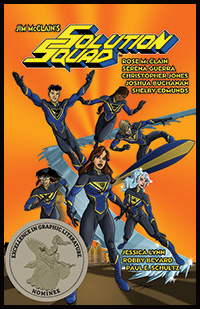
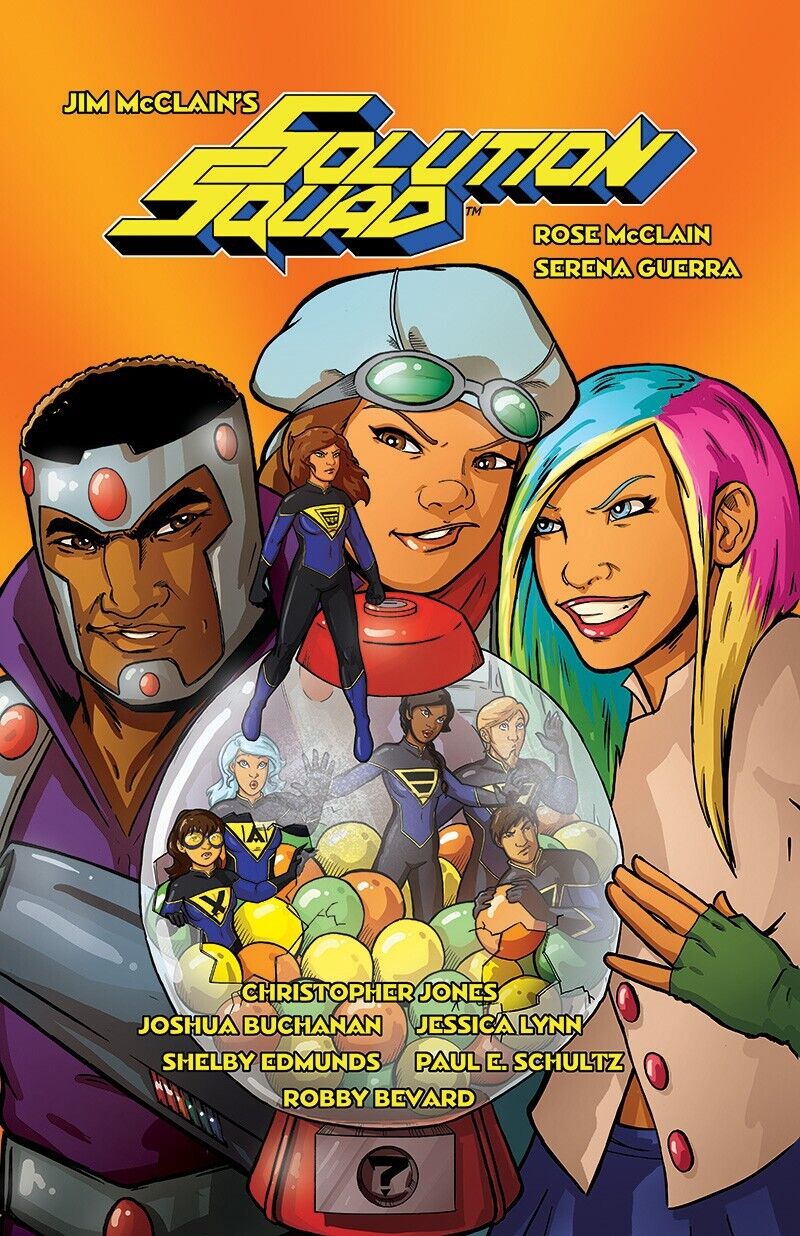
I didn’t get to go to Comic-Con again for several years. The experience had been a little overwhelming, to say the least. The convention had dwarfed all the others I had attended. But it only got bigger as time went on. The next time I went was in 2016, when I was working on Solution Squad. I applied to present a panel there, and was accepted. I participated in another panel, as well. And as an all-ages author participating in panels, I was invited to the Scholastic party being held on the rooftop of a nearby hotel. It also served as a release party for Raina Telgemeier’s Ghosts graphic novel. If you don’t know Raina’s name, she is the queen of American graphic novels. She is also one of the most down-to-earth people you’ll ever meet. This whole experience was another surprise! I got to pitch Solution Squad to an editor there, but it wasn’t something they were publishing at the time. I was disappointed, but not too surprised about that.
I received one of the gift bags that they had set aside at the party, and it contained an uncorrected proof copy of the book. My daughter, who was 10 years old at the time, was a near-celebrity for having a copy before any of her friends did. I had fun just hanging out with my dear friend Tracy Edmunds, with whom I worked on so many projects. I had lunch with Tracy and her daughter Shelby, who I was meeting for the first time. Shelby went on to color some stories for me. She’s very talented!
Another pleasant surprise occurred when I got to meet my favorite Superman writer, Elliot S! Maggin, whom I didn’t even know was going to be at the convention. He was there to receive the Bill Finger Award, which is given to writers who have not previously been recognized enough for their work. Elliot was not only my favorite Superman comic book writer, but had also authored two Superman prose novels that meant a lot to me (and still do, actually) when I was young. I was thrilled at the opportunity to meet him.
Me with Elliot S! Maggin, Comic-Con 2016
I got teased about wearing a Batman shirt when I took a photo with him. If I’d known he was going to be there, I would have worn a Superman shirt!
At this same convention, I got to meet Steven E. Gordon, who had long been a Facebook friend, but also created the cover for my first comic book! Steve was the character designer for X-Men Evolution, one of my favorite cartoons.
The main cast of X-Men Evolution
When I initially started pitching Solution Squad, I described it as “X-men Evolution meets Numbers.” So it seemed natural to ask him to do the cover of my first comic book.
The cover of Solution Squad #1, drawn by Steven E. Gordon and colored by Eric Gordon
It was also a nice time seeing friends from the old Clobberin’ Times amateur press alliance, a publication I belonged to 30 years ago.
Me with my buddy Tim Watts, before he went all grey!
The last time I went to Comic-Con was in 2019, a year ahead of the pandemic. Out of the three panels I submitted, the one I was least prepared to give was accepted. I went with my two buddies, Scott Wiles and Jon Loftus. I did have a good time, but there was definitely a damper on my enjoyment. At that point in my comics career, I was beat. I was tired of doing conventions. I was tired of travel, and I was tired of pretty much everything to do with it, especially the crowds.
The line to get into the main convention floor, 2019
That said, I made the most of the convention. It’s often said, “Comic-Con isn’t about comics anymore.” Well, it is if you make it about comics. I spent the majority of my time among the comics dealers in the vendor room, and found a ton of comics I wanted. There were comics, old toys, original art, you name it. It’s all there if you look for it. I got to see my friends Chuck, Steven, and Elliot again. I got to pick up merch from my friend Katie Cook, supporting her web comic Nothing Special, of which my daughter is a huge fan.
Katie Cook is always easy to find at a convention. Look for the longest line!
I also made a point to pick up con-exclusive merchandise that I could re-sell later at a premium to help pay for my trip.
Never in my life did I imagine there would be an action figure set like this!Thanks to Tim Watts and Aaron Storck for being at my panel!
Again, seeing friends from the Clobberin’ Times was great. Tim Watts and Aaron Storck were on hand for my panel. It’s always great catching up.
When I returned home, I was exhausted. Of course, that was the last convention before the pandemic happened, so I’m sure it hasn’t been the same. I know I have no desire to go again. The pandemic changed me permanently. I don’t like traveling by air anymore, and I don’t like large crowds at all. But I sure enjoyed the times I went and I don’t regret any of those trips!
Superboy #240, cover by Mike Grell and Joe Rubinstein
Normalcy was not something I was used to. And my life at 13 was, I want to say, as close to normalcy as I ever had. I had school, I had friends, I had a loving family, and I had my weekly trips to the grocery store to buy comics, trading cards, or candy
It’s kind of funny, reading back over the stories that I’ve told thus far. The stories seem focused on the things that I bought. And I guess, in a way they are, because I was not allowed to have these things for a long time. In the five years that I lived with my mom and stepfather, candy, for example, was strictly forbidden. We could occasionally be allowed half a stick of gum, and it was only Wrigley’s Doublemint. Visits to Dad’s and Grandma and Grandpa McClain’s house were exceptional. But to not be able to have the simple joy of an occasional jaw-breaking Bazooka Joe or a bag of M&Ms just seemed oppressive.
I’ve written before that my favorite candy bar was the Marathon bar, but there were other times when I just wanted to try something I had always seen on a grocery store shelf and wanted to try. Bottle Caps became another favorite of mine.
Bottle Caps are, as you can see, “The Soda Pop Candy,” and it came in the different flavors of pop. Strawberry, orange, grape, cola, root beer, I enjoyed them all. I still remember wondering if adding some to water would make a kind of pop without the fizz, but that was a failure. But hey, at least I was free to try! The great thing about Bottle Caps is that I didn’t have to eat them all at once and could save them over a couple of days. I still occasionally indulge in these when I buy groceries. I save them for family movie night.
The other candy I could savor was Spree.
Spree was fun because the flavors were so bright. There was a candy coating, but once you got past that, the phosphoric acid took over.
We had open lunches, even in junior high, and could walk downtown if we so chose. Many of my friends would go and get food or candy, and that’s how trends started. And while Jolly Ranchers were popular, the Jolly Rancher Stix candies were more popular with our crowd. They were long, flat versions of Jolly Rancher flavors that could be sharpened down to a shiv. The most popular one, though was the Fire Stix.
Fire Stix were a bargain because they lasted forever. If you were careful how you unwrapped it, you could put the wrapper back on and put it in your pocket to enjoy later. I loved cinnamon candy in general, and when I stayed with my dad, I often got a pack of Big Red gum, which became available in 1975! Way better than that old Doublemint.
If I was really lucky, I could get a Plen T Pak!
17 sticks of gum!
It just seems so odd to think about these things now as a highlight of adolescence. They should just be things that were part of every kid’s life. But to me, now, they represent something else. It’s no wonder I still indulge in these sweets. They bring memories of happiness, lifted spirits, and finally having the freedom to make decisions for myself.
In the glory days of high school, when I had left comics behind, there were still ways for me to enjoy my favorite superheroes. For some reason, reading comic books was scorned, but reading novels about comic book superheroes was A-OK. Following his successful Superman novel, The Last Son of Krypton, Superman scribe Elliot S. Maggin cooked up a doozy.
Published in 1981 as a movie tie-in to Superman II, even though they had nothing in common except the main character, Miracle Monday tells the story of the demon, C.W. Saturn, sent on a mission to destroy Superman’s morals. To do so, he inhabits the body of time-traveling journalist Kristin Wells, who has joined Superman’s supporting cast to research Miracle Monday, because in the future, no one knows why it’s celebrated. By creating a situation where Superman will be forced to kill his host, Saturn taunts Superman, even going so far as to reveal the Man of Steel’s identity to the world.
The great thing about this novel is that Maggin gets the heart of Superman. He does good. He fights to preserve life. And for goodness sake, he doesn’t kill. Ever. There’s a scene in the first chapter where Pa Kent is having a nightmare about his son simply killing the criminals he stops. The boy takes over a delicate eye surgery and humiliates the surgeon. He even offers to take over the country’s military because he’s going to be running things anyway. In the dream, Pa, as a last resort, goes out to a field to find some buried Kryptonite and agonizes over what he might have to do, but Superboy is there, and takes the shovel away, swings it at Pa, and Pa wakes up. Pa goes to his boy’s room, where Clark is examining a dead grasshopper. Pa gets a might nervous about it, until Clark explains that he wasn’t the one who killed it. He just wanted to find out why it died where there were no obvious signs. Pa is relieved that his son values life.
And all of that is just part of Chapter 1.
What Elliot Maggin really digs into in this novel is how Superman perceives the world. With all of his fantastic senses, he sees colors that no one else can see. He doesn’t bother to name them because there’s no one with whom he can talk about them. And he sees the energy given off by living things. There is a scene where he is distracted by a conversation with Lana Lang on the school bus, when it accidentally hits an old dog from a neighboring farm. Clark can literally see it die as its energy dissipates and goes cold. It upsets him so much that he gets physically ill. It’s all part of growing up to be Superman:
Art by me again!
Without going into excruciating detail, Elliot Maggin’s Superman novels, both of them, were instrumental in the formation of my morals. This is no Man of Steel Superman, which I found to be as cold and lifeless as the dead dog. This is my Superman, more along the lines of Christopher Reeve. And honestly I don’t care if it’s corny. It was the foundation of a successful and beloved character for almost 50 years before John Byrne’s reboot in 1986 turned Superman into a Marvel character. There’s nothing wrong with Marvel characters. It’s just that Marvel was already publishing plenty of them. This Superman was fundamentally good.
Another wonderful aspect of this Superman, particularly in Maggin’s books, is his relationship with Lex Luthor. In the 1986 revamp, Luthor was turned into a middle-aged scientist/businessman. Back when this novel was published, Luthor and Superboy grew up together in Smallville. They were even in the same class. They weren’t rivals. Luthor literally had no peer. But his ambitions always got the better of him and he learned harsh lessons by having to go to reform school. Luthor is not just a two-dimensional figure in Maggin’s hands. He’s devious, yes. A criminal, sure. But he maintains several separate identities to perpetuate his criminal activities, even when he’s incarcerated. It’s not LexCorp as it was presented in the 80s, but LexCorp’s seeds are certainly found here. And Luthor even attended classes at Metropolis University in one of his many guises, and Superman, as Clark Kent, tries one last time to reform him, to bring him to the light. He’s even ready to reveal his secret to Luthor, but the criminal refuses the meeting. After all that, this is a Superman who never gives up on him. Even at the end of the novel, Superman asks the time-traveling Kristin:
“Just one thing. Do I ever make friends with Luthor again?”
She thought about how to tell him and how much to tell him. He was Superman, after all, she had to tell him something. Finally, she just whispered, ‘Someday.’”
No, this Superman is not hard core. You would never see him with glowing red eyes. He would not destroy most of a city just to fight Zod. This Superman is about hope, and I don’t mean some alien symbol that looks to us like an S. This is also a Superman not written exclusively for children, as we often hear said in today’s jaded exposition, calling him a “boy scout” or a “do-gooder.” This is the most complete version of Superman you could ever read about. And if you don’t believe me, ask Mark Waid, who is often credited with writing some of the best modern Superman stories:
“Miracle Monday is my textbook on Superman, who he is, and who those around him are. My textbook.”— Mark Waid
Elliot Maggin has published a second edition of Miracle Monday. You can find it here. You would be doing yourself a favor to read both of Elliot’s Superman novels.