“Kellog’s PEP! P-E-P. That super-delicious cereal presents…The Adventures of Superman! Faster than a speeding bullet! More powerful than a locomotive! Able to leap tall buildings in a single bound! Look, up in the sky! It’s a bird! It’s a plane! It’s Superman!”
Now, if you don’t remember Kellogg’s Pep, that’s okay. I don’t, either. It was discontinued some time in the 1970s. From what I understand they tasted a bit like Wheaties. Pep was one of the first vitamin-fortified cereals, but I know it because of its close association with the Superman radio show, which ran from 1940 until 1949. I listen to the old-time radio show every single day on my way to and from work, and in fact, whenever I’m driving the car anywhere. Some time ago, I bought a 5-CD set that has literally hundreds of episodes of the show on it, and I just let it play and play. For most of its run, The Adventures of Superman was comprised of 15-minute episodes that played every afternoon, the time of day depending on locale. As a serialized story, there was a lot of repetition to keep kids who may have missed an episode up to speed. But the stories move pretty quickly, for the most part. I have a couple of the CD sets released by Radio Spirits almost 20 years ago, as well as a big cassette set featuring Superman along with Batman & Robin, who often guest-starred with the Man of Steel.
As I’ve mentioned before, much of the Superman mythos first appeared on radio. It can’t be understated how much the radio program contributed to Superman’s popularity. But I think my favorite part of the show’s portrayal of Superman is what a complete character he is. He’s no musclebound lunkhead, as he’s sometimes stereotyped to be from the comics. He’s an investigative reporter with as sharp an intellect as Batman’s. Even moreso on this show, because there are times when he makes Batman look simple by comparison. Well, I mean, it’s Superman’s show. He’s the star, right? But the number of times he nearly gives himself away when talking about himself while he’s in his Clark Kent disguise (more on that in a minute) is high. Very high.
It’s a more modern contrivance, thinking of Superman as really being Clark Kent’s disguise. This started in the 80s when John Byrne rebooted Superman. Gone was his past as Superbaby, or even Superboy. Superman simply became the public persona of the adult super-powered farmboy who didn’t even know where he came from. But back in the 1940s, Superman was his true persona, and Clark Kent was the disguise. In fact, it was in the second episode of the radio show when Superman, soon after arriving on Earth as an adult, and after rescuing a professor and his son from a runaway trolley car in Indiana, asks for their help in coming up with a human name for him to use as his disguise: “How about Clark Kent? That’s ordinary enough.” It’s also their idea for him to become a newspaper reporter, at “a great metropolitan.” That way he can learn quickly about where he’s needed.
As the radio program progresses, Superman’s cast of supporting characters solidifies. We have Lois Lane right away, of course, and “grey-haired editor, Perry White.” But when cub reporter Jimmy Olsen comes along, it was a whole new ballgame. Jimmy Olsen was just as important a character, if not moreso than Lois Lane. Jimmy didn’t just get into trouble. Jimmy provided the everyman’s perspective for Superman. He was our window into Superman’s world. He traveled the world with Clark Kent, despite being 14 years old and allegedly living with his mother. At one point I was considering compiling a list of skills that Jimmy picked up on their adventures, but it would be a towering list, only exceeding his injuries by a small margin. That kid would have been the poster child for CTE by the time he was an adult, and he’d have more scar tissue than an Alex Ross image of Batman. He was shot, stabbed, shocked, poisoned, and nearly drowned more times than I can count. He probably developed immunity to a dozen diseases, too. He was like a modern-day Rasputin.
Just like the show, I have to interrupt this blog post to talk about Kellogg’s Pep. When the show began without a sponsor in February 1940, they made dummy commercials to demonstrate what the show could be. “Brought to you by Blankareens!” But it wasn’t long before Kellogg’s Pep became the show’s sponsor for years. Kellogg’s provided premiums with their cereal, including cardboard warplanes, and mail-away walkie talkies that “look like the real thing and really work.” They came with 50 feet of cord so you could talk “clear across the playground.” There was plenty of air given to buying war bonds during World War II was well. But perhaps the best Pep prizes were the comic buttons.
Our pal Dan McCullough was constantly talking to us about our collection of 18 comic buttons that come in Kellogg’s Pep. He’d always start his pitch with, “Hey, gang!” and then he’d launch into how these comic buttons would look swell pinned to our “jacket, or dress, or cap,” and “what a thrill it was to swap duplicates with our pals. Why, they look so real, you expect them to come to life! And you don’t send any money in, not even a boxtop. And you can’t buy them anywhere. Just ask your mom to get you a package of P-E-P, Kellogg’s Pep!” Seriously, that was off the top of my head because I have heard the pitch so often!
Well, Dan had never heard of EBay, because guess what I got in the mail today. Why, Superman himself!
I have to be honest, after all these years of listening to Dan tell the gang how true-to-life these comic buttons were, I was a little disappointed that they were smaller than a nickel.
But hey, I finally have one of those swell prizes from Kellogg’s of Battle Creek!
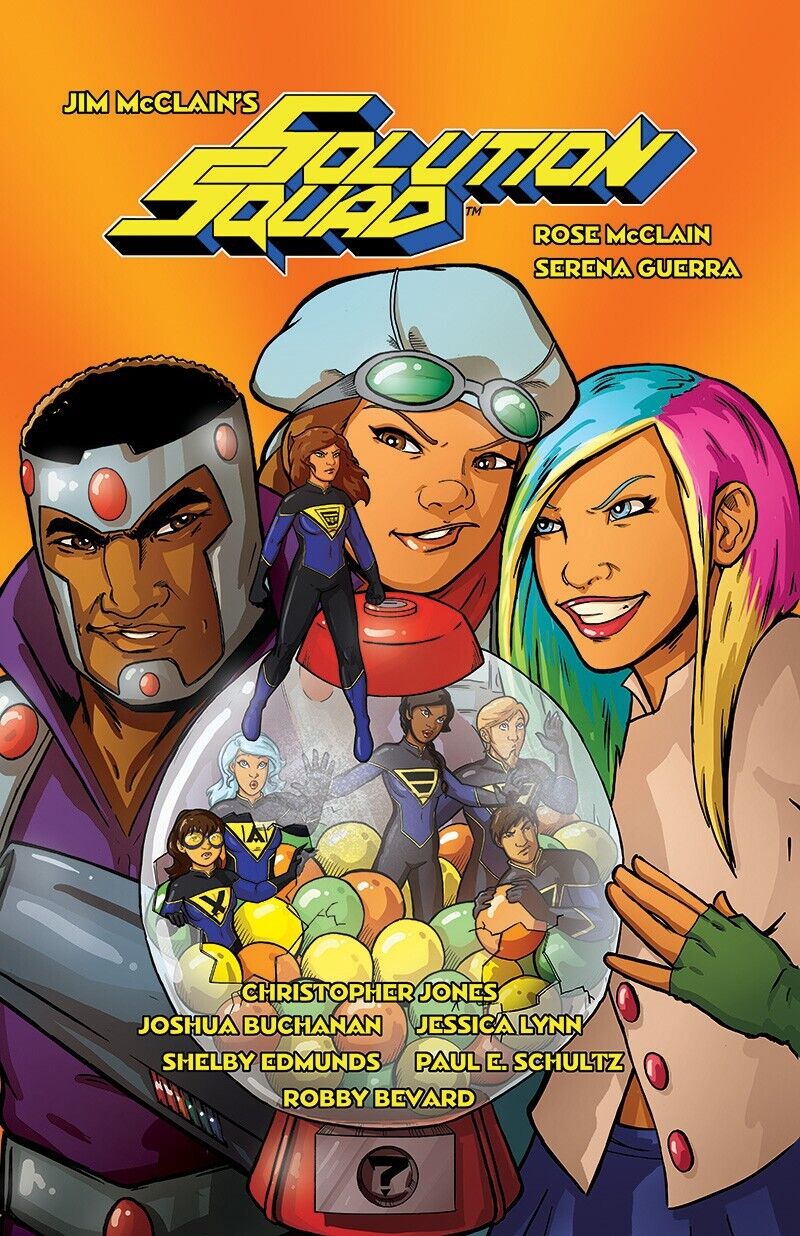
People ask me how, since I’m retired and don’t make comics anymore, do I keep my brain from rotting due to disuse. Well, I have a new hobby. As you may have read here or here, Mego action figures were among my very favorite toys when I was a kid. I just wasn’t allowed to play with them at home. I had written an entire Solution Squad story about eight-inch action figures, and one of my buddies had customized a Radical figure for me, which appears on the cover.
I tried my very best to emulate the blister card from the World’s Greatest Superheroes line that Mego produced in the 1970s, right down to the circles featuring other characters with their names encircling their head shots. It wasn’t easy! Radical’s head was made from a repainted Shaggy (from Scooby Doo) with some scupted hair and beard add-ons. His costume was printed! So cool.
My very favorite Mego was the first one I received for Christmas in 1972, Superman, which you can see young Radical playing with here, in a flashback.
As fun as it was, the Mego Superman’s cape was far too easily frayed. I don’t know whatever happened to my old Mego figure. It probably got tossed during one of our many moves. But I do know that he was well loved and well used, and his cape showed it. A few years ago, I acquired one that was in near-mint condition, and I bought a cool diorama from a buddy who sculpts them out of foam to display him permanently.
The next one I got as a kid, in 1974, was a Captain Kirk figure from Star Trek. When my brother got Spock, we had many adventures together. Both of those figures stayed with my brother when I moved away. But the one thing I always wanted was the USS Enterprise playset. I yearned for it, but it was not meant to be. Well, last summer, I found both. I bought a set of the first series of Star Trek figures released in 1974. Uhura was added in 1975, but was still considered in the first series. They can cost quite a bit in good condition, and these were pristine. They had all their weapons, delta insignias, their hair paint was unmarred, they were just perfect. With one exception; Captain Kirk’s leg was broken at the knee.
Now, I am not a handy person. My grandpa and dad did their best to make sure I was at least competent with tools, and when I was younger, I used to make things in my grandpa’s garage. But I never built models, or worked with glue very much. I always preferred drawing. But, I thought, for the price I’m getting this set ($120), I can at least attempt to repair a Mego leg. I would have never considered it when I was a kid, but then again, we didn’t have YouTube back then. Sure enough, I found a video explaining how to replace a knee pin, which is what was missing from Kirk’s leg.
I replaced the pin from a bag of cadaver Megos I had gotten alongside the Superman a few years before, and ironically, a Superman corpse gave up his knee pin so that Kirk could stand again!
In the end, it really wasn’t complicated at all. But I felt accomplishment, nonetheless. Paying only $20 each for mint (-1) Star Trek figures was really cool. And then when the Enterprise playset popped up for less than $100, I knew I had to have it, finally, after all these years! My shelf looked like a Christmas catalog item from 1974!
In the box for the Enterprise was also an extra Captain’s chair and black stool. I didn’t think too much about them, and just tossed them in a box with my cadavers. We’ll get back to them, though.
I thought that would be the end of the hobby of collecting Megos. But then I found out that Mego was back in business after decades of companies trying to do what they did. I had seen some of the newer figures with their fancy correctly-painted weapons and stuff, I dismissed it. Bah! New things! But then I discovered that they had finally produced Sulu and Chekov figures with their original-looking blue phasers and communicators!
The bridge crew would be complete! And what’s this? The impossible-to-find Romulan figure was being re-released with its red weapons set! I couldn’t have a Klingon on the bridge without a Romulan!
By then, I was in my new office, and had a much better display space for my beloved Enterprise set.
And, I thought, if they re-released the Romulan from the Aliens set from series two, maybe they did the Gorn, too! The Gorn figure, if you are not aware, was perhaps the worst and cheapest figure that Mego produced. There was nothing original about it. It utilized a repainted head from Marvel’s Lizard figure, the body from a Planet of the Apes Soldier, and a Klingon uniform. Parts is parts, right?
But the new Mego did not spare the detail! They made a real Gorn that looked like the one in the show!
Naturally, I had to have one. But where was I going to put it? I ran into my diorama-building friend Mike Sutter at a toy show, and put to him an idea. Could he make Vasquez Rocks for me? You know Vasquez Rocks. It’s a park in California where everything has been filmed, including the episode where Kirk battles the Gorn, Arena.
Well, Mike knocked it out of the park. I even got the new version of Kirk for the diorama.
When I discovered that the new shelves in my office were too narrow for the full diorama, I asked Mike if he could trim them down to nine inches wide. He agreed, and asked what I wanted done with the rest. I asked if he could use them to make another diorama, the Guardian of Forever from the episode, City on the Edge of Forever. And again, he crushed it.
But I didn’t want to move my wonderful Kirk and Spock from the bridge set, so off to EBay I went to buy the cheapest Kirk and Spock I could find. I got the pair for $40, but they didn’t come with weapons. I thought, well, that was hardly relevant to this display, so I didn’t worry about it. But it made me think, how hard would it be to just get a set of weapons? Apparently, much harder than I thought! A vintage weapons belt with the blue phaser, communicator, and tricorder can set you back $50! But I wasn’t done with this piece, yet. I needed another Dr. McCoy figure, and I didn’t want to pay a lot for it. I had just found another Kirk and Spock online for even less than I paid for the first pair, just $25, and I had replaced the new Kirk with the Gorn with the classic Kirk. The Spock figure had problems, though, He had a Type-1 body, and his legs were splaying out like crazy. You guessed it, I found a YouTube video. I ordered some 2 mm elastic cord and bought a crochet hook at Walmart. After two attempts, I had completely restrung the figure, making it as good as new. However, I didn’t need a Spock figure at the moment, so he sacrificed his uniform to go with a Type-2 McCoy body I had in my cadaver box. One of the things Mego saw in the Star Trek line was cheap production. The only difference between a McCoy figure and a Spock figure was the head! The McCoy figure had been a gift from my friend Tracy Edmunds, whose father-in-law had bought it in the 1970s to use as a driver in his model race cars. His head was completely messed up from having helmets glued to it, but his body was in perfect shape. I found a McCoy head on EBay for ten bucks and boom! Instant Dr, McCoy figure. Still no weapons, but the good doctor had lost his phaser in 1930s New York in that episode anyway. And now I have a Type-1 Spock figure in my spare Mego box. When another blue uniform comes along, he’ll be dressed again and I’ll have another nearly complete figure.
While that really wasn’t true customization, just a parts swap, I kind of wanted to try my hand at it. My first attempt was to make my Star Trek Adventures captain, by modifying a new Kirk uniform with fabric paint. It was a disaster. I thought I had better stick to what I could handle and not modify the clothes too much. If I try it again, I’m going to try gluing fabric over the existing fabric. I just need a couple of black panels, not a complete dye job.
I thought I would start my journey more successfuly by making a redshirt. If you don’t know that term, it refers to one of Star Trek’s many casualties, who often wore red shirts for security, and often didn’t even have names. But there was one who not only had a name, but he appeared in 57 episodes, more than even Sulu or Chekov! His name was Leslie…most of the time.
Lt. Leslie, played by Eddie Paskey
One of Mego’s new lines was Married With Children, and I had read that they were trying to go cheap on sculpts again. They were pulling old sculpts from everywhere, and they chose one that someone had made of Eddie Paskey, who played Lieutenant Leslie on Star Trek, to make Al Bundy’s head. This was supported when I got a look of the side view of Al’s profile.
I’m pretty sure Al Bundy never had those Starfleet sideburns! So, I thought, let me try making a custom Mr. Leslie figure. I took that now-shirtless Kirk figure, and popped off his head, and replaced it with the head of Al Bundy. I found a Scotty uniform shirt online for a fairly low price, and ordered it. Scotty was the only figure Mego produced in the old days who wore red. Leslie most often wore red for engineering or security. But I had also read that you could simply repaint Mego figures with the same paint you use for D&D figures, and I had some. So, I got to work repainting the head with a color more suitable for Leslie while I waited for the Scotty uniform to be shipped. When it arrived, I used an X-Acto knife to cut away one of the rank braids (Scotty was a lieutenant commander while Leslie was just a lieutenant), and put it all together. I borrowed one of my classic figure’s weapons belts to complete the look.
My first successful custom Mego: Lt. Leslie
Since I’m not worried about vintage weapons for this figure (the only part of him that’s vintage is his shirt), I looked for reproduction Star Trek weapons. And wouldn’t you know it, Dr. Mego has some! Instead of $50, I can get a full belt for eight bucks. And I have plenty of other figures that don’t need vintage weapons, but would display better with weapons than without. That site has replacement parts for everything we need to restore our 50-year-old figures and make them look new again! Okay, now I had a taste for customizing as well as repair.
There’s been a movement not just to sculpt Mego heads but to print Mego heads made of resin. And one that came up in my wanderings was one that I really want to make: Luke Skywalker.
It’s well known that Mego passed on the Star Wars license in 1977 and that decision factored into the company’s eventual demise. Kenner took up the toy license and instead of making expensive eight-inch figures, they focused simply on molded and painted 3.75″ figures that were far cheaper to manufacture and much more flexible in the types of figures that could be offered. It was a trend that even Mego adopted afterward, when they tried to keep up with their Star Trek license for Star Trek The Motion Picture. But I often wonder what it would have been like if Mego had made the Star Wars figures. So, I’m going to try to make one. I painted Luke’s head (so out of practice) and attached it to an extra Type-2 body I had. I noticed that the foot was broken, and yep, right to YouTube, learned how to pop out the ankle pin and replace it with a donor part.
Appropriate that he’s in front of a Star Wars game, right?
I’ve ordered a black bodysuit, and a pair of replacement boots for CHiPs figures to make a start on Jedi Luke. Yes, CHiPs boots are correct.
While I was in reconstruction mode, I dug back into my box of parts, where I found a Planet of the Apes figure. I honestly did not have any interest in these figures when they came out in 1974, so I didn’t even know the character’s name.
A trip to the Mego Museum page, and it was revealed! His name was General Ursus…or General Urko. It depended on when you bought him! That page is really a nice resource, because you can find out what parts a particular figure came with to be complete. This figure did not have his rifle or his scabbard and short sword, and like Star Trek weapons, they can be really hard to come by. But, because of his condition (really nice), I decided to complete him. It took a couple of weeks to find the parts, but I did. So, I spent $55 to complete a $150 figure. Pretty cool.
The Completed General Ursus/Urko
Here is where the new hobby is satisfying. I took parts from three incomplete figures and made a whole one. There’s just something right about that. It feels good. So I took a good look at my parts box and started making notes. Remember that extra captain’s chair from the Enterprise box? I sure don’t need it, but someone evidently does!
Just like there’s a market for Mego weapons, there is a market for any spare parts, even heads! I have an extra General Ursus head, and I don’t need that either.
So, to answer the question from the first paragraph, how am I keeping my brain from rotting? I’m doing math. I’m looking for parts lots that complement what I already have, and selling what I don’t need. Here’s the pièce de résistance:
I have a Klingon figure. Its head was in good shape, as was the uniform, and one of his two boots. His knee, though, had been replaced not with a plastic pin, but with a bolt and nut! I can’t even fix it because more damage was done to the leg when someone did their best knee replacement without YouTube.
Metal knee replacement before its time
So, I took a spare Type-2 body from a Robin figure with a messed up head, and did a transplant. Now I just needed a weapons belt and a boot replacement. Vintage boots are $20 a pair. Or, if you want a single boot, the price is…$20. The whole figure is only worth about $40. I was not about to pay $20 for boots. So, instead, I found a whole Klingon. Wait, what? Well, yes, the Klingon figure is whole, but…his head is messed up and the uniform pants have a few minute problems. That reduces the value. So, I paid $35 for this whole (messed up) figure, and I will take the boot and the weapons belt, to make a whole, good, sellable-condition vintage Klingon figure, and I could sell the remaining parts. Sounds crazy, but I could get $20 for the good boot, and $15 for the Type-2 body, and–are you following this? I could get $35–what I paid for the whole figure–for the leftover parts of this figure that are undamaged. I’m not going to, though, because I’m going to keep gathering an inventory of spare parts to complete more figures later on. I will probably ditch the defective pants, though. I think I might experiment more and repaint the head, too, since its paint defects make it not as valuable.
So, no, my brain isn’t going to rot. I’m on a constant watch now to find parts that go with my parts. It just becomes important now to keep track of what I have on-hand.
Everyone, take a bow! Your time will come. You will be complete again!
I’ll get back to my summary of the second half of the second season of Strange New Worlds in a bit. But for now, Subspace Rhapsody is now my favorite episode of Star Trek of all time and I need to get this out!
We knew there was a musical episode coming, and I wondered how well that would fare with Star Trek fans, who can be very unforgiving. But I found the episode to be completely chaming. The Enterprise encounters a naturally-occurring subspace fold, and Spock thinks that it can be used to increase the speed of their communications across the sector by a factor of three. Subspace radio is Star Trek’s magical way of allowing faster-than-light communication in a universe where they traverse dozens of light years in a matter of days. So, this would be a big deal. Unfortunately, the fold doesn’t appear to want to transmit their signals. When chief engineer Pelia suggests music to take advantage of the nature of harmonies, they give it a try. Uhura sends “the great American songbook” through the phenomenon, and the results are…spectacular.
Spock inexplicably bursts into song (Status Report) while offering a routine report on the effects of the phenomenon. Then music is heard throughout the ship, and each member of the crew gets a verse to sing, just like in a Broadway musical, touching upon each character. There is some real genius going on in this scene, as helm officer Ortegas and navigator Mitchell, even find their hand movements on their control panels to be synchronized. That clues us in that it’s not just singing we’re in for!
Then we are treated to an a capella arrangement of the Strange New Worlds theme. Some viewers may not even have noticed.
As the crew searches for answers, their fundamental truths are revealed and their individual storylines are wrapped up. And once more, James T. Kirk is inexplicably on the ship. The Farragut must follow the Enterprise like a lost puppy! Una notices that La’an “has an energy” about her as they prepare to beam him in. La’an dodges the remark, for the moment. As Kirk is receiving a seminar from Una on how to be an effective first officer, they have a slight disagreement on command style, which leads to a duet in Gilbert and Sullivan style, called Connect to Your Truth. We know that Una loves Gilbert & Sullivan from references in episode two, and the Short Treks episode, Q & A. The pair even dance, while La’an looks from around a corner, observing that they are revealing more about themselves than they perhaps intend to.
When La’an returns to her cabin to address her feelings, she belts out How Would That Feel, where she explores her feelings for Kirk, and how those feelings have changed how she sees herself. She’s even questioning her entire way of behaving and wants to experiment with sharing her feelings. This is a real moment of character growth for La’an, but it’s tempered when she realizes that she could inadvertently reveal things that she is not allowed to because of the events of episode three. She is not allowed to reveal what happened in the alternate timeline and understands that it could pose a security threat. So, the change in her paradigm is delayed.
The next number, a duet between Captain Pike and his sometime paramour Captain Batel (who finally gets a first name, Marie) is played for laughs as they try to have a Private Conversation, only to have their personal business and raw emotions laid out in front of their entire crews–until La’an cuts off communication to prevent any further emotional and professional damage. When Spock reveals that the damage is spreading through the entire subspace network, Pike is then convinced that they need to stop the phenomenon from doing more harm, even extending into the Klingon Empire. “No one wants to hear a singing Klingon,” Una says. I heartily disagreed!
When La’an doesn’t want her feelings toward Kirk revealed, Una sings to her about how keeping things secret really doesn’t work for her anymore, in Keeping Secrets. Things start to get a little more serious as a group of Klingon ships is about to arrive and destroy the subspace fold, which Spock has found to be a fatal mistake. It would destroy the Federation and half the Klingon Empire. To come up with a tactical plan, La’an recruits Kirk to help her, and somehow they have an emotional moment without a song. Kirk has sensed La’an’s attraction, but he’s in a relationship right now, and his partner Carol is pregnant. This relationship of course was revealed in Star Trek II: The Wrath of Khan, and the pregnancy will result in the birth of Kirk’s son, David. But knowing how that relationship will end does raise the question of whether Kirk will eventually come back to La’an. This episode has layers on top of layers, because in season one, episode 10, La’an is serving as Kirk’s first officer on the Farragut in the future timeline, and appears as happy and free as she wishes she could be.
As Spock and Uhura race to find a way to shut down the effects of the fold, they discover that the phenomenon is following the rules of the American musical, and that the music is occurring when strong emotions are too much to express simply in spoken words. As an example, Chapel is celebrating with friends in the Port Galley, because she has been accepted to the fellowship she applied for back in episode five’s Charades. As soon as they burst into song (I’m Ready), Uhura starts taking readings before chiming in, while Spock stands helplessly by and watches his relationship with Christine dissolve before his very ears. This one of the most ambitious numbers in the show, with a whole room of dancers, very much in the style of Chicago. But in the end, Chapel just cuts Spock’s heart out:
“It’s freedom and I like it My spark has been ignited If I need to leave you I won’t fight it
I’m ready.”
As Uhura and Spock struggle to find a pattern that will allow them to escape the phenomenon, Spock finds himself emotionally compromised, and his pain is released in a reprise of I’m Ready. This is my favorite song in the whole episode, so I’m going to quote the entire thing here:
This news really changes everything I can’t believe how wrong I’ve been Convinced myself we shared the same feelings I won’t make that mistake again
She’s happy and carefree The opposite of me I can do the calculus
For her I set aside My need to analyze Now I’m racked and Searching for why I’m the ex
I’ve got no one but myself to blame I’ve betrayed my core philosophy Unbending reason must be my true north Lеst I drown in this sea of pain
I’m so dysfunctional Weak and emotional Feelings I just can’t contain
Escaping this misery Or breaking free Not a possibility
I’ll solve for Y in my computation But miss vital information The variable so devastating
I’m the X I’m the X I’m the X
This is just so clever, the interchangeable use of ex and X, why and Y, I love the whole thing. This sets Spock down the path we know he’s destined to walk. “Unbending reason must be my true north” defines the Spock we know from the Original Series, and who we got to see in A Quality of Mercy‘s alternate timeline, again weaving the idea of fate in and out of this whole prequel series.
This breakup also adds a new dimension to the Spock/Chapel relationship in the Original Series. Instead of a simple unrequited love on Chapel’s part, this new dynamic provides a different take. Spock was in love with her and she broke his heart. He retreated into logic and she realizes that she made a mistake and is trying to get him back, and he rebuffs her, harshly for the most part, especially when he goes into Pon Farr in Amok Time. It’s just really well done.
Spock is overwhelmed and leaves Uhura to find a pattern on her own, as she often finds herself, and in the course of doing so, discovers her true purpose in Keep Us Connected. She finds that enough voices singing could produce a spike of 344 giga electron volts (bound to be a popular trivia answer) and destroy the fold. She persuades Pike that they need a “grand finale” to survive.
Uhura leads the entire ship into their final song, We Are One, which is great, but the true highlight is when Pike orders Uhura to hail the approaching Klingons, who then break out into a boy band song. I’m not kidding, I belly laughed. It was perfect. Even the starships were choreographed by the end of the number and the subspace fold was gone. The crew celebrates, all smiles, except for Spock, who gives Chapel a serious look as he turns away from her, and you can see on her face that she knows that she has hurt him badly. She tries to make the best of it with her other crewmates, though.
Spock makes amends for involving the Klingons, calling back to the first episode of the season, when he showed a willingness to drink blood wine, again weaving plotlines gracefully throughout the show.
Batel concludes that she and Pike will settle on their desired vacation spot after she comes back from a priority-one mission she just received from Starfleet, and you just have a feeling that that’s not going to go well. Still, such a good show. Such strong character development, and they even explored something brand-new!
“Welcome aboard the USS Challenger. I’m Captain Jeff Chamberlain. If you’ll step down off the transporter pads, we’ll begin our tour.
Captain Jeff Chamberlain, deck 3 corridor, USS Challenger
“Before we begin, I’d like to give you a little context about Challenger‘s mission. In just a short time, the USS Enterprise should conclude its five-year mission, the only Constitution-class starship out of the original 12 to do so. The other 11 starships succumbed to the dangers of space exploration. The USS Intrepid lost all hands to a giant space amoeba near Gamma 7A. The USS Constellation was destroyed while battling the so-called Doomsday Machine near L-374. The crew of the USS Exeter were killed while investigating Omega IV.
“The Hood, Potemkin, Excalibur, and Lexington were severely damaged due to the runaway M-5 computer. The Excalibur lost all hands and was set adrift, while the Lexington sustained severe damage to the engineering section but was able to continue in its mission. I served aboard the Lexington, and lost my best friend, Chief Engineer Harold Bichel. I continued serving under Commodore Wesley as the new chief engineer until the Lexington, too, met its demise to an aggressive D-7 Klingon cruiser near Beta-Delta XII. I was part of the surviving crew who had to stay alive on the class-L planet for 40 days until help arrived. My back was broken, and I can tell you that it was a long 40 days. That’s where Challenger comes in.”
“During my recovery at Starbase 1, I petitioned Starfleet to create a new kind of ship and mission. I had plenty of time flat on my back in the medical bay to work on my proposal. Using all the data from every ship in Starfleet to that point, I outlined and addressed the weaknesses that led to the destruction of the ships and the loss of their crews. At the same time, I examined the non-sentient parts of the Enterprise that have contributed to its singular survival. All of these traits have been incorporated by Admiral Krause at Tycho Starship Yards into one prototype: Challenger. Now, I understand that the Enterprise will be getting overhauled. I’ve seen some of the fancy new engine designs that they’re planning. I wanted none of that. I wanted the most reliable, dependable, tried and true technology that Starfleet had to offer. Challenger may be the first, last, and only ship of its kind. She’s a forward-looking throwback. She’s the size of a Constitution-class starship, but she only crews 204. I’m hoping you’ll be part of that crew. Each of you were recommended to me by your individual captains.
Comparison of Constitution-class and Challenger-class
Challenger‘s mission is not one of exploration. Challenger‘s mission is crisis and emergency response. You won’t find state-of-the-art astrophysics labs or stellar cartography decks onboard. You will find an entire deck of emergency crew quarters to house survivors and refugees. You will find large cargo holds to transport medicines and grains. And you will find an expansive shuttlecraft bay with no fewer than 16 N-type Javelin shuttlecraft for emergency evacuation and rescue.
“But I’m getting ahead of myself. Let’s start at the top. If you’ll follow me…”
Turbolift, USS Challenger
Shhkkkt.
“Computer; bridge.”
Shhkkkt.
Vrrrrrrr
“Such a satisfying sound, isn’t it? I understand that newer ships will have silent doors. I think that’s a shame. As you can see on the deck plans here, there are two turbolifts that go to the bridge. We typically use the main turbolift on the port side of the communications station. We reserve the secondary turbolift for emergencies. During my convalescence, I read too many incident reports of crew being trapped on the bridge after an incident with the sole turbolift being taken out of commission.
Shhkkkt.
Bridge, USS Challenger
“Captain on the bridge!”
“Shin, you’re the only one here.”
“Yes, Captain, except for the recruits you’re bringing on.”
“You have me there. Everyone, this is Lieutenant Shin Ch’tolnan, one of our tactical officers. It’s something new we’re trying out, separating the weapons systems from the conn. It’s enough to have to fly the ship under duress. It is thought that a dedicated weapons alcove would be more efficient. It’s one of the changes I didn’t come up with, but seems like a good idea.
“As you can see, there are two security stations, one for internal security and one for weapons systems. If necessary, they can be manned by two crewpersons. Shin knew we were coming because of an alert from his station. So, the port side of the bridge is typically manned by engineering or security officers. Communications is right behind the captain’s chair.”
Bridge, port stations, USS ChallengerLt. (j.g) Shin Ch’tolnan, junior tactical officer, USS ChallengerBridge station layout, USS ChallengerBridge, starboard stations, USS Challenger
“Over on the starboard side, we have Landing Party Monitoring, the medical station, and your typical science station. The interesting one is Landing Party Monitoring. You’ve probably noticed the device on my uniform that looks like a belt buckle. It’s called a Perscan, and it automatically feeds biometric data back to the ship via subspace link. It also helps maintain a transporter lock without relying on a communicator, which can be lost or taken away.
Perscan deviceMain bridge seen from viewscreen, USS Challenger
“And obviously, we have navigation, the helm, and the captain’s chair. Nobody really ever gets this view, since you have to stand in front of the viewscreen to get it. All right, take a good last look around and head to the main turbolift. You remember which one is the main lift, right?
“It’s the one on the port side. If you ever forget, it’s the one with the dedication plaque next to it.
Dedication plaque, USS Challenger
“Get back on that simulator, Shin. You need to get up to speed.”
“Aye, Captain.”
Isometric view of bridge, USS Challenger
Shhkkkt.
“Computer, deck three, aft.”
Vrrrrrrrr
Shhkkkt.
“Here we are, back on deck three. Deck two is taken up by a docking port. I was against that idea, because it provides easy access to the bridge for intruders, but I was overruled. Once we get underway, I’ll probably have the chief engineer weld it shut. Once we have a chief engineer, anyway.
Conference room, deck three aft, USS Challenger
“This is the conference room. On Constitution-class ships, the conference room was too far away from the bridge to be of practical use most times. In situations where solutions are not obvious, I always invite suggestions from my staff, and even debate, right up until I make my final decision.
“I like this room because it provides a good view of the nacelles. I may be a captain, but I’m still an engineer at heart.
Isometric view of conference room, USS Challenger
Shhkkkt.
“Also on deck three, we have transporter room one, where you beamed in. The Constitution-class ships had four transporter rooms. We have eight, and each one has eight pads and a cargo pad instead of the previous six-pad platforms. When we dedicate enough power to it, we can transport 80 people at the same time. That means we can move our entire crew in about two minutes if they’re standing by.”
Lt. Hal Bichel, security/communications officer, USS Challenger
“Ah, and Hal got here while we were gone to stock the armory. Everyone, this is Lieutentant Hal Bichel. Hal is a rare breed. She is both a communications and security officer. She had a double focus at the Academy.”
“What’s that, Commander? She has the same last name as my best friend? That’s not a coincidence. He was her father. Hal was with us on the Lexington when she was just a cadet. She’s also my goddaughter. Let’s–go ahead and continue our tour. I’ll see you later, Hal.”
Isometric view of Transporter Room 1, USS Challenger
Shhkkkt.
“Computer, deck five aft.”
Vrrrrrrrr
Shhkkkt.
Isometric view of Sick Bay, USS Challenger
“Pretty impressive, right? Here we are in the aft section of the middle of deck five, in the most heavily protected part of the ship. This is unchanged from the Constitution-class. None of the Sick Bays ever took direct hits in combat. This, however, is one of the most advanced medical facilities in Starfleet, only second to Starbase 1, though capacity is smaller, for obvious reasons. Sick Bay even has its own dedicated transporter room.
“Oh, and look who’s lurking about. This is Dr. Jenn Carmichael, my personal pain in the–”
Dr. Jenn Carmichael, nerve specialist, USS Challenger
“Don’t you say it, Captain. And speaking of backsides, have you done your physical therapy yet?”
“I’m getting to it. I’m a little busy, as you can see.”
“Captain, if you want to keep your command, you will do your physical therapy twice a day. I may not be the Chief Medical Officer, but I’m responsible for YOU.”
“Yes, Ma’am. Hey, everybody, remember how I told you that I broke my back? Well, turns out there was a little permanent nerve damage that went with it, which also happens to be my nickname for Lieutenant Carmichael. My sciatic nerve acts up from time to time. Good thing Starfleet made a new rule about landing parties. Captains pretty much stay in their chairs unless it’s absolutely necessary. And I have a really good chair.”
Office of the Chief Medical Officer, USS ChallengerMain bio bed room, USS ChallengerPhysical examination room, USS ChallengerLt Commander Brag bav Blav, trauma counselor, USS Challenger
“Oh, and look who it is! Dr. Brag bav Blav, everyone. Our trauma specialist. How’s it going, Doc?”
“How do you think it’s going, Captain? I just restocked my Saurian brandy. Again. I’m having Bichel put up a security force field on my display. These the new recruits?”
“Hopefully.”
“Well, I can’t wait ta get inside yer heads, kids.”
“Uh, okay, then, let’s continue, everyone.”
Shhkkkt.
“Computer, deck 16. aft.”
Vrrrrrrrrrrrrrrrrrrrrrrrrrrrrrrrrrrrr.
Shhkkkt.
“And here we are in my favorite place, Engineering. I saved the best for last.
“Over to the side is Auxiliary Control, where we can actually operate the ship if the bridge is compromised. And over here you see the warp core. What’s wrong, you’ve never seen anything like it? Well, my friend Woody, there, can tell you why. He’s the Assistant Chief Engineer. Lieutenant Wooderson?”
Lieutenant Chadwick “Woody” Wooderson, assistant chief engineer, USS Challenger
“All right, all right, all right! You must be the new recruits Cap’n has been trying to woo. This here is the fastest warp engine ever devised. Challenger has been rated for sustained speeds of warp factor eight, but we can push her up to warp nine if we have to. Of course, we can’t shoot when we go that fast, but you can’t have everything. She’s got some giddyup, and she purrs like a kitten at warp six. The only thing she don’t like is sittin’ still.”
Upper deck of engineering, USS ChallengerJeffries tube, USS Challenger
“Thanks, Woody. As you can see the warp core is installed vertically, requiring a second floor, which is new. And yes, we have a Jeffries tube for control access. No one likes to go in there, and hopefully no one will have to.
Isometric view of engineering, lower deck, USS ChallengerIsometric view of engineering, upper deck, USS Challenger
“Well, that pretty much concludes our little tour, unless you’re excited by cargo bays and crew quarters.
“If you’re still interested in serving aboard Challenger, I’m reviewing applications for the next several days. I look forward to reading yours.”
Credits:
Ship and shuttlecraft design by Bill Krause, @buckadmiral on Twitter, @admiralbuck on Instagram
Interiors by Craig Shoosmith, @tekknonerd on both Twitter and Tumblr
Learning to read in the 1960s with Batman comics and the Batman TV show, it’s small wonder that I identified with Robin, the Boy Wonder. Always at Batman’s side, Robin gave kids, boys especially, someone to project themselves onto. Wouldn’t it be cool to be Batman’s sidekick? To ride along in the Batmobile? Robin was portrayed as about 16 on the Batman TV show, but in the comics by 1969, he was going off to college, so mark him down as 18 years old. He got aged up just a bit so that Batman would have darker solo adventures. He was still around 18-19 years old in comics in 1980, when the New Teen Titans got started. Time passed oddly in the DC universe. Yet, still, he led a whole superhero team at a pretty young age and had a lot more responisbility than most kids his age. When Marv Wolfman and George Pérez matured him for their book, it was time for a new Robin to be at Batman’s side. Dick Grayson abandoned his Robin identity in New Teen Titans #39, which I bought on my very first visit to a comic book store, mentioned here.
This was an exciting time to be reading The New Teen Titans. Longtime readers had been introduced to their newest member, Terra, and many fans thought she was just great. But when it was revealed that she was actually a spy working for Deathstroke, the Terminator, well, the wheels were about to come off the wagon. Suddenly, Dick Grayson discovered that his entire team had been ambused and were missing, and he was fresh out of yellow capes. By summer, the conclusion of “The Judas Contract” storyline was about to conclude, and Dick Grayson needed a new costumed identity.
So, after 44 years of being Robin, Dick Grayson became Nightwing. Now, before we get too far, here, I just want to point out that many barbs have been thrown toward this costume as somehow being inspired by disco because it has a raised collar. Uh, no, you mooks out there. It was inspired by the circus. You know, like Deadman? The other superhero in a circus costume?
Dick Grayson, having been a circus performer, obviously went back to his history to pull out that costume design. It was 1984, for crying out loud. Disco was gone.
Anyway, the comic where this transformation took place, Tales of the Teen Titans #44, was published in July 1984. I had just finished my freshman year of college, the second semester of which being much more successful and enjoyable for me. I had a steady girlfriend whom I had started dating in February, and I was down in Kalamazoo visiting her, when this comic book came out. But I also had a rare opportunity. My brother and sister were also in southwestern Michigan, with my mother and stepfather. They were staying couple of towns over at my stepfather’s parents’ house. I volunteered to come over and get them, and take them to the movies. My mother agreed. So, my girlfriend and I drove over to pick them up. Let’s see, I was 19 at the time (the same age as Nightwing), so my brother would have been 13 and my sister, 12. I took them to see what every kid that age should have seen that weekend: Indiana Jones and the Temple of Doom. Despite the more, uh, terrifying aspects of the Raiders prequel, they had fun and I had the unique feeling of being a true older brother, taking my younger siblings to the movies in the summertime, something I hadn’t really gotten to do, living apart from them as I did.
I enjoyed the Nightwing character, especially the part where Grayson was honoring Superman’s Kryptonian heritage as well. For many, many years of World’s Finest, the Batman-Superman teamup comic, Robin worked closely with both men, and I thought it was a nice touch to make a callback to that time. Nightwing was originally a costumed identity that Superman took on in the bottled city of Kandor, naming himself after a Kryptonian bird. Jimmy Olsen, of course, was his Robin, taking on the name Flamebird.
From Superman #158
Unbelievably, Dick Grayson has been Nightwing now for 39 years, almost as long as he was Robin. There have been some, let’s say, unfortunate choices along the way. The mullet, the ponytail, both a few years after they had been in style, for example. Having him be shot in the head and becoming an amnesiac, leaving a scar that looks like his symbol? That was rough. But more recently, the character has been given a new life, using his inhertiance to make life in his city better than perhaps Batman ever could. It’s good stuff.
It’s easy to get jaded by adolescent behavior when the kids are growing up substantially differently than you did. “These kids spend all their time on their phones!” “They never go anywhere! They don’t even want to learn to drive!” I hear it all the time. But as I was scrolling through TikTok one night before I went to sleep, as I often do, I kept encountering a band called Burn the Jukebox. They were doing a cover of a Foo Fighters song. I thought, you know, they’re not bad. And I watched a couple more of their videos, and I have to tell you that I was impressed by their range. They covered bands like No Doubt, Alice in Chains, Rage Against the Machine, and even A-Ha and Dexy’s Midnight Runners. Then I got hit with a brick. They’re 15 and 16 years old.
Luke, Virgina, Ethan, and Carter, of Burn the Jukebox
Once you reach a certain age, it’s honestly difficult to tell how old kids are, even if you’re a teacher. Some 16-year-olds look like they’re 22. Some look like they’re 12. So, when I saw one video celebrating Virginia’s sweet 16, I was taken aback. These kids have been playing together for three years! They post something new just about every day, and their skills are already impressive. They’ve done tours already, too.
The Internet, being what it is, provides the expected negative commentary: “They reek of privilege!” “That guitarist has a million dollars worth of pedals.” They answer with maturity and unexpected candor. Their parents were musicians, too, and are very supportive. And they’ve bought their equipment with gig money, you know, just like a “real” band would. And believe me, they are a real band. It’s great to hear them honoring the past with the songs they perform. But they also answer their critics who say they should make their own songs. They DO. They have their own original songs that they perform and release. It’s just that the cover songs they produce draw views to their various channels. It’s a successful tactic; it’s what got my attention.
This is the kind of story that makes me happy. It’s kids being kids, following their dreams, not allowing negative people to tear them down, and proving naysayers wrong. Good on these kids!