It’s Comic-Con week again, and I’m preparing myself to see people hating on Comic-Con because “it’s not about comics anymore,” and I’m preparing to see people boast about not being there, because of some hipster sense that they’re too cool or not cool enough to go. You can take your pick there. You can see people who are hyped for Hall H and people who are offended that people attend things in Hall H. And I’m already seeing people who are enthusiastically promoting their own appearances and panels that they’re doing.
Here’s my take:
Comic-Con is exactly what you make of it. I’ve been to it three times, the last two times as a professional. And each time, I’ve found exactly what I was looking for. You want comics? There are a ton of creators there that don’t generally appear in the midwest. There are booths and booths and booths of new comics, old comics, original art, supplies, and anything else you could ever need for the hobby of collecting comics. There are multiple panels going on simultaneously, with information being given out by experts on everything in the field. I was privileged to participate in three of them in my pro days, which if you haven’t put it together yet, are over.
My favorite Comic-Con experiences came as surprises, like the first time I went. Back in 2004, my wife and I visited her sister and her husband when they lived in San Francisco. My wife had asked me if there was anything else I wanted to do in California during the time we were scheduled to be there. I joked, “Well, Comic-Con is going on that week…” She laughed it off and nothing more was said about it. It was just a pipe dream. As it turned out, my brother-in-law was actually going to be away from home for part of the week for that very reason. I was jealous. He was working for Industrial Light and Magic at the time, and was actually working on Star Wars Episode III. He arranged a visit to Skywalker Ranch for us, and even snuck me into ILM itself, which was against the rules. It wasn’t in the Presidio back then, but in a strip mall across from a Circuit City in a completely unmarked building. Super cool. When it came time to say goodbye to him so he could head to the airport, my wife told me to pack an overnight bag. I didn’t understand. She said, “You’re going with him.” Without my knowledge, they had planned the whole thing from the beginning!
We caught our plane at 6 AM, landed in Los Angeles at 7:30 AM, and Jeremy rented a convertible to drive the rest of the way down to San Diego. We got there, found a hotel (those were the days) and hopped a bicycle cab to the convention center. Jeremy was an industry pro, and registration was not quite as stringent as it is now, and he got us passes for two days based on his credentials. I was in heaven. The first thing I did was, of course, say hello to all the people I knew in Artist Alley. Jeremy was impressed that I seemed to know everyone, and that they knew me. It wasn’t quite that extensive, but it was a lot. Then he introduced me to someone he worked with at Blur Studios, Chuck Wojtkiewicz. I sputtered, “You drew Sultry Teenage Super-Foxes!” I thought poor Chuck was going to crawl under his table. He had also drawn Justice League of America for a bit, but I mean, who’s going to remember that? I got to meet Chris Claremont, writer of my favorite X-Men comics, and I bought a hardcover of that book for him to sign. But the key person I was thrilled to meet was Brent Eric Anderson.
Anderson, who drew my favorite comic book series of all time, Astro City, was all by himself with no line. I gushed like a fanboy and told him that I had several of his original pages from Astro City. I asked him for a sketch of The Confessor and Altar Boy, and now that sketch sits right in front of me in a place of honor on my art wall in my office.
Jeremy met with other Blur Studios alumni while he was there, including the owner, Tim Miller, who took his entire group, including me, to lunch. Now, if the name Tim Miller sounds familiar, it should. He directed Deadpool. So yes, thanks to Jeremy, I get to say that I was taken to lunch by the director of Deadpool. And if Chuck Wojtkiewicz’s name didn’t sound familiar before, it’s only because he was an unsung hero working on Deadpool. Chuck storyboarded the entire “12 Bullets” sequence of that movie.
What a trip!
I didn’t get to go to Comic-Con again for several years. The experience had been a little overwhelming, to say the least. The convention had dwarfed all the others I had attended. But it only got bigger as time went on. The next time I went was in 2016, when I was working on Solution Squad. I applied to present a panel there, and was accepted. I participated in another panel, as well. And as an all-ages author participating in panels, I was invited to the Scholastic party being held on the rooftop of a nearby hotel. It also served as a release party for Raina Telgemeier’s Ghosts graphic novel. If you don’t know Raina’s name, she is the queen of American graphic novels. She is also one of the most down-to-earth people you’ll ever meet. This whole experience was another surprise! I got to pitch Solution Squad to an editor there, but it wasn’t something they were publishing at the time. I was disappointed, but not too surprised about that.
I received one of the gift bags that they had set aside at the party, and it contained an uncorrected proof copy of the book. My daughter, who was 10 years old at the time, was a near-celebrity for having a copy before any of her friends did. I had fun just hanging out with my dear friend Tracy Edmunds, with whom I worked on so many projects. I had lunch with Tracy and her daughter Shelby, who I was meeting for the first time. Shelby went on to color some stories for me. She’s very talented!
Another pleasant surprise occurred when I got to meet my favorite Superman writer, Elliot S! Maggin, whom I didn’t even know was going to be at the convention. He was there to receive the Bill Finger Award, which is given to writers who have not previously been recognized enough for their work. Elliot was not only my favorite Superman comic book writer, but had also authored two Superman prose novels that meant a lot to me (and still do, actually) when I was young. I was thrilled at the opportunity to meet him.
Me with Elliot S! Maggin, Comic-Con 2016
I got teased about wearing a Batman shirt when I took a photo with him. If I’d known he was going to be there, I would have worn a Superman shirt!
At this same convention, I got to meet Steven E. Gordon, who had long been a Facebook friend, but also created the cover for my first comic book! Steve was the character designer for X-Men Evolution, one of my favorite cartoons.
The main cast of X-Men Evolution
When I initially started pitching Solution Squad, I described it as “X-men Evolution meets Numbers.” So it seemed natural to ask him to do the cover of my first comic book.
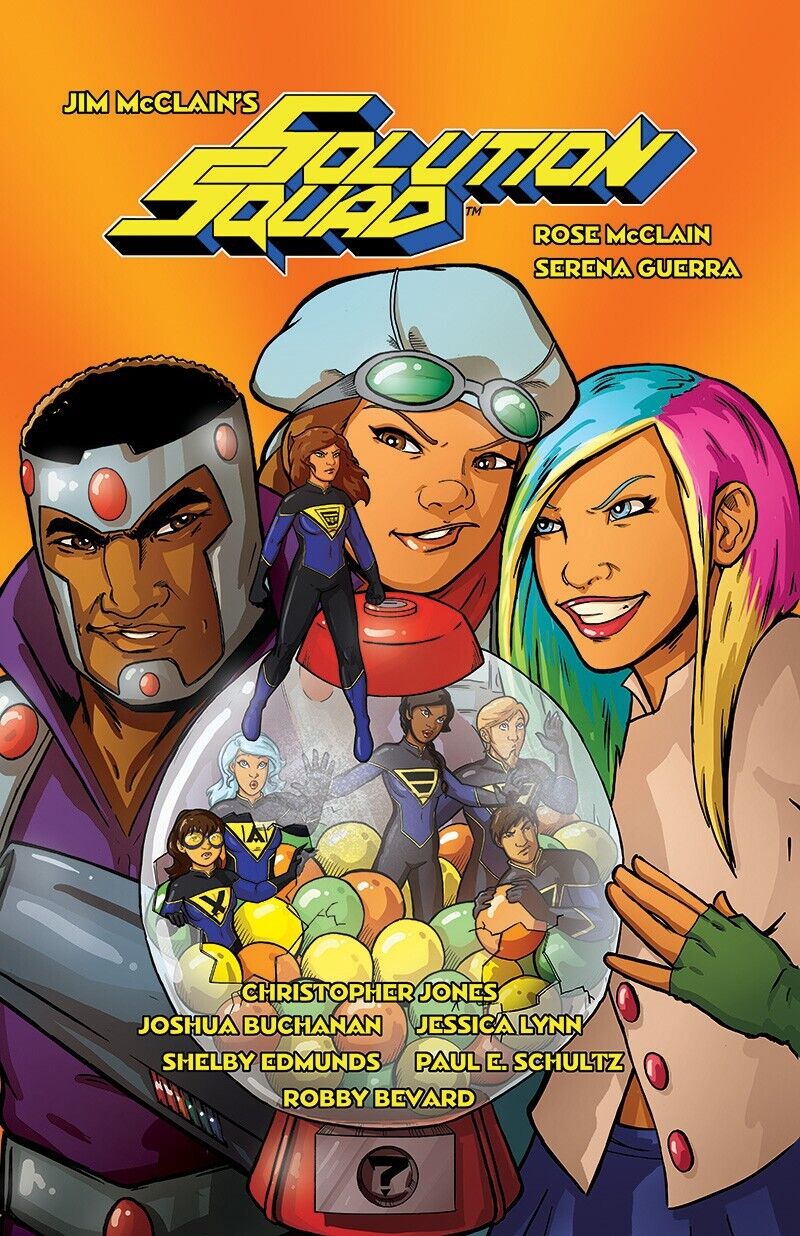
The cover of Solution Squad #1, drawn by Steven E. Gordon and colored by Eric Gordon
It was also a nice time seeing friends from the old Clobberin’ Times amateur press alliance, a publication I belonged to 30 years ago.
Me with my buddy Tim Watts, before he went all grey!
The last time I went to Comic-Con was in 2019, a year ahead of the pandemic. Out of the three panels I submitted, the one I was least prepared to give was accepted. I went with my two buddies, Scott Wiles and Jon Loftus. I did have a good time, but there was definitely a damper on my enjoyment. At that point in my comics career, I was beat. I was tired of doing conventions. I was tired of travel, and I was tired of pretty much everything to do with it, especially the crowds.
The line to get into the main convention floor, 2019
That said, I made the most of the convention. It’s often said, “Comic-Con isn’t about comics anymore.” Well, it is if you make it about comics. I spent the majority of my time among the comics dealers in the vendor room, and found a ton of comics I wanted. There were comics, old toys, original art, you name it. It’s all there if you look for it. I got to see my friends Chuck, Steven, and Elliot again. I got to pick up merch from my friend Katie Cook, supporting her web comic Nothing Special, of which my daughter is a huge fan.
Katie Cook is always easy to find at a convention. Look for the longest line!
I also made a point to pick up con-exclusive merchandise that I could re-sell later at a premium to help pay for my trip.
Never in my life did I imagine there would be an action figure set like this!Thanks to Tim Watts and Aaron Storck for being at my panel!
Again, seeing friends from the Clobberin’ Times was great. Tim Watts and Aaron Storck were on hand for my panel. It’s always great catching up.
When I returned home, I was exhausted. Of course, that was the last convention before the pandemic happened, so I’m sure it hasn’t been the same. I know I have no desire to go again. The pandemic changed me permanently. I don’t like traveling by air anymore, and I don’t like large crowds at all. But I sure enjoyed the times I went and I don’t regret any of those trips!
After high school graduation, I went to work in the same factory where my dad worked: Four Winns Boats. I started at $4.25 per hour, which was significantly better than the minimum wage at the time, $3.35. I was a vinyl puller, also known as an upholsterer. I was one of the people who took the wooden frames that made boat seats, stapled foam on the boards, and stretched the sewn vinyl seat covers over the frames, stapling them down with an air-powered staple gun. It was repetitive work, as there were only two kinds of seat frames I was responsible for, the ones that formed loungers. There was a seat and a back. Each set was two seats and two backs. Someone down the line would assemble them together so that the back-to-back boat seats would expand out so that you could lie down on them. In very short order, I was the fastest puller they had. It was virtually mindless work, and I enjoyed it after four years of high school.
The only problem with the job is that it came with a price. I had to quit my high school baseball team, while we were still playing in the state tournaments. My dad had arranged this job, and if I continued on in the tournament for two more weeks, the job wouldn’t be there anymore. Regrettably, I folded up my uniform and turned it in. I felt like I was letting my friends, teammates, and coach down, but on the other hand, I felt like it was time to grow up. I would need this money for college, especially because my dad lived by the philosophy that since I was 18, I had to pay my share of the rent, even though I didn’t even have my own room in his one-bedroom apartment. I slept on a futon in the living room. I also needed to buy a car, and soon.
Ironically, my high school graduation gift from my parents was a car, a 1974 Chevy Nova that my dad had bought for himself. He got my mother to donate $350, half its perceived value of $700, and he gave me the car; allegedly. My mother was furious. Basically, she paid him $350 for his car and he “gave” it to me. Until he didn’t. Right about that time, my aunt and uncle’s car broke down completely and they needed a replacement immediately. My dad gave them my car. How he gave them MY car, I’ll never know, but like Vin Diesel says in those stupid Fast & Furious movies, it’s about family. I guess. So, there I was, without the car that had been given to me as a gift. It took a few weeks, but along with the graduation gift money I had received from some of my more scrupulous relatives, I scraped up enough to buy myself another car, this time a 1974 Ford Pinto station wagon. Since I paid cash for it, this one had a title in my name and no one was giving it to anyone! I loved that car. It was orange and had mag wheels for some reason. I removed the AM radio it came with and installed an AM/FM/cassette boat stereo and speakers from Four Winns in it with my own hands. Electronics class at the Wexford-Missaukee Area Vocational School really paid off! I even bypassed the normal fuse box so that the stereo could play without the key in the ignition. Now I had freedom that no one would ever take away from me. Because my dad worked second shift and was a supervisor, I was not allowed to work on the same shift, so I worked days. That and having a car freed up my evenings to do whatever I wanted.
One of the first things I did was go to a movie by myself. Yes, I could have gotten a date, but this was special. Return of the Jedi was out in theaters, and I didn’t want to embarrass myself by taking a girl to see it. I had already suffered enough jibes from my former classmates for liking this genre. It wasn’t like it is now. So, one evening, I plopped down in a seat by myself in the Cadillac theater with a big bucket of popcorn and a Coke, and settled in. Toward the end of the movie, an unfamilar emotion washed over me. You see, Star Wars had come out when I was 12 years old, the summer before I started junior high. Luke Skywalker was a simple farmboy. When its first sequel, The Empire Strikes Back was released, three years later, I was a high school sophomore. I literally drove my family to see the movie with my learner’s permit in hand. Luke was in his adolescence very much the same as I was at the time. And now, at the end, Luke’s hero’s journey came to fruition, as he proclaimed himself an adult. “I am a Jedi, like my father before me.” I didn’t need to be beaten over the head to recognize the parallels. I had come of age. Young, yes, but I was paying my own way. I had a job and a car that I had bought with my own money, and would soon be on my way to college and the rest of my life. The possibilities were endless.
June was filled with graduation parties, so there was always somewhere to go in the evenings. I loved grad parties. All the turkey, ham, and roast beef you could eat, always on the same rolls. I think everyone used the same service to get their food. There was almost invariably a keg, too, but I wanted nothing to do with beer. Pop was my drink of choice, and Mountain Dew was my favorite. Coke would do as well, though. Since I was now paying for my own food, I appreciated free dinners almost every night! Quite often, when I stayed until the end of a party, I would do my good deed and help clean up, and parents would often beg me to take home leftovers. I would, and those became my lunches at work, wrapped up and packed in my Igloo cooler that I had bought the previous summer for the Christmas tree trimming patch. I took that cooler everywhere, even to the drive-in for movies.
When my brother Jeff, who was 12 at the time, came for visitation that summer, I took him to the drive-in so that we could see some cinematic masterpiece like Spacehunter: Adventures in the Forbidden Zone. We made a bag full of popcorn using the air popper my dad and I had gotten when I was in eighth grade, and put a six-pack of pop in the cooler with ice. I had a dub of Michael Jackson’s Thriller on cassette, and my brother thought it was the greatest album ever made. We played it again and again. It felt good to be a big brother, because I knew what he was going through at my mom’s house.
I took girls to the Cadillac drive-in, too. You might as well just queue up Bob Seger’s Night Moves, so I don’t have to go into detail. I know I remember going to see Flashdance at the theater with one of my high school crushes, but I didn’t see much of the movie.
Later on in June, I traveled down to Kalamazoo for Western Michigan University’s orientation. I had to take a couple of days off work to do it, and I didn’t appreciate losing the money, but it was highly recommended for incoming freshmen. I had never driven a long-distance trip like that before, so it was exciting. What was not exciting was driving the Pinto, which didn’t have air conditioning. When I got there, I saw parents dropping off their kids everywhere, and I was just all by myself. It felt strange but exhiliarating at the same time. We got marched all over campus, touring the facilities, taking placement tests, even applying for work-study for fall. We were also introduced to some of the slightly off-campus offerings, like Bilbo’s Pizza. Named, of course, for the main character in The Hobbit (which I had never heard of), it was a Middle-Earth-themed pizza place, complete with round oaken tables and dark lighting. The only pizza restaurants I had ever sat down in were Pizza Hut and Little Ceasar’s, which yes, had sit-down locations back then.
This was well before Hot ‘n Ready, and even before Pizza! Pizza! was a thing. It was still a cheap-looking place, nothing at all like Bilbo’s. So my small-town self was impressed by the ambience that a real pizza place provided. And the pan-style pizza was pretty good, too!
That visit made me excited. I could hardly wait to start a new life on campus. I had kind of walked away from several of my high school friends at the time. When my two best friends (I thought) planned their graduation parties together and left me out, I got the message that I was not wanted. So, I started making new friends. One of my newer friends was Brian Goodenow, a Pine River student I knew from my class at the Wexford-Missaukee Area Vocational Center. We had been in the same electronics class. Brian was a DJ at WATT, AM 1240, which was only a short drive from my apartment. I spent a lot of time hanging out with him while he was on the air. And I made another new friend at work, Ron Radawiec, who had also gone to Pine River. Ron’s dad had just opened up the very first video rental store in Northern Michigan, so Ron and I would often rent movies to watch at his house when we had nothing else to do. I found the video cassette recorder to be a magical tool, and I envied theirs. Of course, you couldn’t afford to own movies. No, the average cost of a VHS movie was $80-90 back then. That’s why you rented them! Three-dollar rentals were expensive, but nowhere near the cost of a newly released movie. And because of my Pine River connections (it was the high school where all of my Tustin Elementary friends went), I even got a visit one night from Janet Johnson and Robin Byers, my sixth grade crushes, with whom I had also reconnected at the vocational school. They were there for nursing. It seemed like my world was getting bigger than the isolated Mesick High School experience.
Moreover, it felt like my life had come full circle, going back to when I first went to live with my dad. Like Luke Skywalker, I had completed the first leg of my hero’s journey.
The first comic book convention I attended was the Return of King Kon back in 1984. It was held on the campus of Eastern Michigan University in Ypsilanti. My roommate, my girlfriend, and I drove to the show, where we spent the day looking at comic books, and meeting the people who made them. That’s where I first saw a copy of Fleischer Studio’s Superman cartoons, which I had read about when I was a kid. I entered a trivia contest and won second place. As an entry gift, I received a copy of Badger #9, and liked it enough that I added it to my monthly list of comics and sought out the previous issues.
I was hooked.
I didn’t have the financial stability to attend conventions regularly until around 1990, after I had graduated from college and was working full-time as a teacher. I taught summer school just to have enough money to do what my friends were doing, which was getting professional artists to draw my Champions characters. Some of my friends had some pretty impressive sketches already. My friend Scott Burnham had taken one of my drawings to a convention in 1988 and had Mike Gustovich ink over my pencils, which was kind of a thrill. I was terrible at inking, and he made my drawing look a hundred times better.
Quantum, pencils by me and inks by Mike Gustovich
Another friend took Scott’s idea and ran with it, getting Neil Vokes to ink my drawing of his character, Firefrost, in 1989:
Firefrost, pencils by me, inks by Neil Vokes
When I attended Chicago Comicon in the summer of 1990, I sought out artists to draw my newest character, Domino. Domino started out as a detective character who wore ordinary street clothes. He was very much inspired by The Question and The Spirit. But he also carried guns, not to kill people, but to defend himself against the higher-powered characters in the word he lived in. I immediate got Bill Reinhold, the artist from The Badger, to ink one of my drawings.
I was also lucky enough to find Steve Mitchell, who was inking a Batman title at the time, but more importantly, had once inked over Frank Miller in 1980!
Domino, pencils by me, inks by Steve Mitchell
I was really starting to see the difference in how an inker can affect the overall quality of the image. But that was really driven home by being inked by Denys Cowan.
Domino, pencils by me, inks by Denys Cowan
I honestly never cared for this piece after that. My pencils were of uniform quality, but the inking was hit or miss, it seemed. I loved Denys’s work on The Question, but this, to me, was not much more than scribble.
But the find of the show had to have been Brian Stelfreeze. Brian was drawing Cycops, a black and white indy book from Comics Interview, and I loved how different his style was compared to most artists. I caught him early in the show, but his dance card filled quickly. He stayed even after the show ended to finish this one up. He turned the paper upside down, and said, “I’m gonna have fun with this.” And he drew it just how you see it here:
Domino, by Brian Stelfreeze
This remains one of my all-time favorite pieces, and it was drawn upside-down! I paid 30 whole dollars for this one. Over the years, I attended this convention and Motor City Comic Con in Detroit several times, and loved the fan experience. I never thought I would qualify to be on the other side of the table. But a boy can dream…
In the glory days of high school, when I had left comics behind, there were still ways for me to enjoy my favorite superheroes. For some reason, reading comic books was scorned, but reading novels about comic book superheroes was A-OK. Following his successful Superman novel, The Last Son of Krypton, Superman scribe Elliot S. Maggin cooked up a doozy.
Published in 1981 as a movie tie-in to Superman II, even though they had nothing in common except the main character, Miracle Monday tells the story of the demon, C.W. Saturn, sent on a mission to destroy Superman’s morals. To do so, he inhabits the body of time-traveling journalist Kristin Wells, who has joined Superman’s supporting cast to research Miracle Monday, because in the future, no one knows why it’s celebrated. By creating a situation where Superman will be forced to kill his host, Saturn taunts Superman, even going so far as to reveal the Man of Steel’s identity to the world.
The great thing about this novel is that Maggin gets the heart of Superman. He does good. He fights to preserve life. And for goodness sake, he doesn’t kill. Ever. There’s a scene in the first chapter where Pa Kent is having a nightmare about his son simply killing the criminals he stops. The boy takes over a delicate eye surgery and humiliates the surgeon. He even offers to take over the country’s military because he’s going to be running things anyway. In the dream, Pa, as a last resort, goes out to a field to find some buried Kryptonite and agonizes over what he might have to do, but Superboy is there, and takes the shovel away, swings it at Pa, and Pa wakes up. Pa goes to his boy’s room, where Clark is examining a dead grasshopper. Pa gets a might nervous about it, until Clark explains that he wasn’t the one who killed it. He just wanted to find out why it died where there were no obvious signs. Pa is relieved that his son values life.
And all of that is just part of Chapter 1.
What Elliot Maggin really digs into in this novel is how Superman perceives the world. With all of his fantastic senses, he sees colors that no one else can see. He doesn’t bother to name them because there’s no one with whom he can talk about them. And he sees the energy given off by living things. There is a scene where he is distracted by a conversation with Lana Lang on the school bus, when it accidentally hits an old dog from a neighboring farm. Clark can literally see it die as its energy dissipates and goes cold. It upsets him so much that he gets physically ill. It’s all part of growing up to be Superman:
Art by me again!
Without going into excruciating detail, Elliot Maggin’s Superman novels, both of them, were instrumental in the formation of my morals. This is no Man of Steel Superman, which I found to be as cold and lifeless as the dead dog. This is my Superman, more along the lines of Christopher Reeve. And honestly I don’t care if it’s corny. It was the foundation of a successful and beloved character for almost 50 years before John Byrne’s reboot in 1986 turned Superman into a Marvel character. There’s nothing wrong with Marvel characters. It’s just that Marvel was already publishing plenty of them. This Superman was fundamentally good.
Another wonderful aspect of this Superman, particularly in Maggin’s books, is his relationship with Lex Luthor. In the 1986 revamp, Luthor was turned into a middle-aged scientist/businessman. Back when this novel was published, Luthor and Superboy grew up together in Smallville. They were even in the same class. They weren’t rivals. Luthor literally had no peer. But his ambitions always got the better of him and he learned harsh lessons by having to go to reform school. Luthor is not just a two-dimensional figure in Maggin’s hands. He’s devious, yes. A criminal, sure. But he maintains several separate identities to perpetuate his criminal activities, even when he’s incarcerated. It’s not LexCorp as it was presented in the 80s, but LexCorp’s seeds are certainly found here. And Luthor even attended classes at Metropolis University in one of his many guises, and Superman, as Clark Kent, tries one last time to reform him, to bring him to the light. He’s even ready to reveal his secret to Luthor, but the criminal refuses the meeting. After all that, this is a Superman who never gives up on him. Even at the end of the novel, Superman asks the time-traveling Kristin:
“Just one thing. Do I ever make friends with Luthor again?”
She thought about how to tell him and how much to tell him. He was Superman, after all, she had to tell him something. Finally, she just whispered, ‘Someday.’”
No, this Superman is not hard core. You would never see him with glowing red eyes. He would not destroy most of a city just to fight Zod. This Superman is about hope, and I don’t mean some alien symbol that looks to us like an S. This is also a Superman not written exclusively for children, as we often hear said in today’s jaded exposition, calling him a “boy scout” or a “do-gooder.” This is the most complete version of Superman you could ever read about. And if you don’t believe me, ask Mark Waid, who is often credited with writing some of the best modern Superman stories:
“Miracle Monday is my textbook on Superman, who he is, and who those around him are. My textbook.”— Mark Waid
Elliot Maggin has published a second edition of Miracle Monday. You can find it here. You would be doing yourself a favor to read both of Elliot’s Superman novels.
Two years ago, I asked my wife if I could buy two “toys” that could be for both my birthday and Christmas presents. I wanted the 1/6 scale Batman and Robin from the 60s TV show that my friend Scott Wiles had just picked up. These things are insane. They come with multiple hands and batarangs bat-cuffs, and radios. And yes, Batman comes with a bomb. Some days, you just can’t get rid of a bomb, you know?
They were $500 for the pair. Crazy money, I know, but bear with me. I got a good deal on them, and I was going to display them in my office/studio, when I finally got it done. I loved this TV show when I was a kid and it was the impetus for me learning to read.
Sideshow Collectibles 1/6 scale Batman and Robin
Well, I started putting stuff on shelves and I dug the two “toys” out, still in their multiple-layered boxes. Just out of curiosity, I looked up their current prices on Ebay. $1100-$1200 for the pair!
Wait. What?
It may be the small town/country kid in me, but I can’t own two toys worth $1200. I just can’t do it. So, this past weekend, I sold them as part of the stuff that I had at the Elkhart Collectibles Expo when I sold everything on my table in one fell swoop. Cleaned out a lot of storage space in my garage, too.
Now, I do like collecting things. I like the thrill of the hunt. I like finding things in unusual places and getting bargains. And while I sold off most of my most collectible things when we adopted Sera, one thing stuck with me for a long time: My vintage Mego Superman. I told the story of it here.
Even at 50 years old, Superman still has it!
When I wrote “The Case of the Eight-Inch Action Figures” for my Solution Squad comics, I remembered what great fun those 8″ figures were. My brother and I eventually had Superman, Spider-Man, Kirk, Spock, Captain Marvel, Kid Flash, Johnny Gage from Emergency, and Hondo Harrelson from SWAT. We could only get away with playing with them at my dad’s and my grandparent’s houses, but we loved them.
This week, I was thinking, well, if I can’t bring myself to have $1200 toys, maybe I can still collect Mego figures. I have been picking up the 50th anniversary set, and last summer I bought a great set of the first six Star Trek Megos from 1974. Captain Kirk came with a broken leg, but I actually had a bag of Mego cadavers that I picked up somewhere or other, and I used a pin from a detached leg to repair him as good as new.
“We can rebuild him…”
So, the other day, I started down a rabbit hole. A few years before Mego made a comeback as a company, there was another called Figures Toy Company and they had produced 8″ figures in the style of Mego in mass quantities. I wanted to see just what they had out there. I immediately found what I was looking for.
Are they Hot Toys quality? Of course not, but I don’t care. They’re $50 for the pair, not $1200! While I was exploring the various figures they had, I was taken by the fact that they also sell blank bodies and heads in various colors. And I thought, I could make my own custom figures, as a friend had done for me with Radical.
I started looking at videos of how to customize Mego figures and I watched one guy just crush an Indiana Jones figure with a 3D-sculpted head, and all he used were cheap acrylic paints and a clear acrylic coat. My eyes aren’t good enough to paint tiny gaming miniatures anymore, but I wouldn’t mind trying my hand at that.
But what compels me to collect things like this? Clearly, the theft of my childhood inspired me to draw a line in the sand, but one would think that after years and years of recovering it, I’d feel complete by now. I don’t. I don’t think I ever will. I don’t play with the toys. They sit on shelves and look cool. But I did play with Mego figures and even make sets for them up until the day I went to high school. My dad, thanks to my grandmother’s advice, let me make up for lost time. But he gently suggested it was time to grow up, especially since I had a job, could drive a car and change its oil, chopped wood with an axe, and worked with power tools. When I started playing football in 9th grade, the desire just kind of went away, especially when I was trying to get the attention of girls.
Since my wife hasn’t threatened to leave me unless I grow up, I guess I’ll continue to enjoy the things I enjoy! Here’s just a sample of what I’ve found online so far:
Action Comics #484, art by Jose Luis Garcia-Lopez and Dick Giordano
There’s a certain bait-and-switch that happens with comic books. Quite often, the cover doesn’t match the contents of the interior. This one was no exception, although the marriage of Superman and Lois Lane does take place within. It’s just that it was the Superman and Lois Lane of Earth-2, the world of the golden age of comics instead of the continuity of the Superman of 1978. And while the outstanding image drawn by Jose Luis Garcia-Lopez sold this comic, the interiors were drawn by Curt Swan, the stalwart Superman artist whose work spanned decades. There is nothing wrong with Curt Swan’s artwork. It’s like comfort food to me. But the dynamism of Garcia-Lopez and just the pure joy expressed on his subjects’ faces always sold me on a comic book. I hoped that one day he would succeed Curt Swan as the regular Superman artist. And then, the very next week, I practically got my wish.
DC Comics Presents #1, art by Jose Luis Garcia-Lopez and Dan Adkins
On the stands was a new title, DC Comics Presents, sort of a companion title to Brave and the Bold, which had been a Batman team-up book for several years at that point. I loved these sorts of team-ups. If I didn’t know anything about The Unknown Soldier, for example, I could learn about him when he teamed up with Batman in B&B. Outside of actual story, it was a way for DC to maintain their trademarks on dormant characters. DC Comics Presents was Superman’s own team-up book. I’m sure they were gearing up for the upcoming Superman movie that people were talking about. There had already been casting rumors flying about in trade magazines, with names like Robert Redford and Sylvester Stallone in the running. But Starlog Magazine #11, earlier in the year, had a photograph of the new Superman, Christopher Reeve!
Unlike the previous week’s Action Comics #484, DC Comics presents had Jose Luiz Garcia-Lopez art throughout the entire book. And it was gorgeous. It was kind of a silly story written by Martin Pasko, featuring a race across time between Superman and The Flash, who had been drawn into a civil war between aliens, but I loved it anyway. As it turned out, years later, I found out from Marty himself that it was not his favorite story. He and I became Facebook friends and had many interactions. My favorite came on his birthday one year:
“Okay, Marty. I’m going to tell you the same thing I told Elliot S Maggin when I met him a few years ago. And it’s the same thing I told Dennis O’Neil when I met him a few years before that:
“I grew up being beaten every day from age seven until age 12, when my mother allowed me to go live with my father, for fear that her new husband was going to beat me to death. The worst thing he did to me was not the beatings, but burning my comic books in front of me, simply as an act of cruelty. My father was not an abuser, but he was also not a very good example to follow. It was his cheating that led to their divorce and my subsequent abuse. But at least he let me (and encouraged me) to read comics. I didn’t have adult male role models in my life. At least not any in the real world. The men who provided that example for me were Batman and Superman. And those heroes were written by real human beings whose names I knew, and you were most certainly one of them. From various issues of Action, up to and including #500 (one of my personal favorites), to DC Comics Presents #1 to various issues of JLA and World’s Finest, you did your fair share of shaping my life going into manhood. I still believe in the values those characters once embodied to this day.
“I’m 53 now, a middle school teacher for the past 31 years. I help shape the lives of young people. I also create comics, and not in the modern sense that we see Batman and Superman now, written for adults. My comics are written for me at age 12 and 13. They’re written for kids who need them, like I needed you guys.
“My 12-year-old daughter reads comics now too, and she also knows your work from Batman: Mask of the Phantasm. At the risk of turning you into the monster you fear, I wanted you to know just how much your comics meant to me as a child, an adult, a teacher, and a father. I don’t know if I’ll get the chance to meet you face-to-face one day, but I wanted you to know all of this before you got another year older.
“Thank you and happy birthday.”
To which he replied, “I’m literally speechless (yes, that’s a joke from Mr. Motormouth, moi). But, honestly and sincerely, Jim McClain: Your deeply moving and beautifully articulated comment is the greatest compliment I’ve ever been paid.”
Marty died not long after that exchange, and I am so very grateful that I had the chance to tell him what his writing meant to me. They say, never meet your heroes, but I think in this case it was one of the highlights of my life.
I also happen to be Facebook friends with Jose Luis Garcia-Lopez. But him, I’ve met in person. I was so looking forward to reading more of the DC Comics Presents series just to see his Superman in every issue, but again, the distribution in my small hometown of Mesic left a lot to be desired, and I never saw another issue of DCP until #26, a couple of years later. I never even got to read the second part of the story that it opened with until I was in college. I admire the Maestro, as he’s sometimes called. He defined what DC characters looked like for an entire generation. You may not know his name, but you know his art.
The 1982 DC Comics Style Guide
1984 Super Powers Action FigureDC Heroes Roleplaying Game