Action Comics #484, art by Jose Luis Garcia-Lopez and Dick Giordano
There’s a certain bait-and-switch that happens with comic books. Quite often, the cover doesn’t match the contents of the interior. This one was no exception, although the marriage of Superman and Lois Lane does take place within. It’s just that it was the Superman and Lois Lane of Earth-2, the world of the golden age of comics instead of the continuity of the Superman of 1978. And while the outstanding image drawn by Jose Luis Garcia-Lopez sold this comic, the interiors were drawn by Curt Swan, the stalwart Superman artist whose work spanned decades. There is nothing wrong with Curt Swan’s artwork. It’s like comfort food to me. But the dynamism of Garcia-Lopez and just the pure joy expressed on his subjects’ faces always sold me on a comic book. I hoped that one day he would succeed Curt Swan as the regular Superman artist. And then, the very next week, I practically got my wish.
DC Comics Presents #1, art by Jose Luis Garcia-Lopez and Dan Adkins
On the stands was a new title, DC Comics Presents, sort of a companion title to Brave and the Bold, which had been a Batman team-up book for several years at that point. I loved these sorts of team-ups. If I didn’t know anything about The Unknown Soldier, for example, I could learn about him when he teamed up with Batman in B&B. Outside of actual story, it was a way for DC to maintain their trademarks on dormant characters. DC Comics Presents was Superman’s own team-up book. I’m sure they were gearing up for the upcoming Superman movie that people were talking about. There had already been casting rumors flying about in trade magazines, with names like Robert Redford and Sylvester Stallone in the running. But Starlog Magazine #11, earlier in the year, had a photograph of the new Superman, Christopher Reeve!
Unlike the previous week’s Action Comics #484, DC Comics presents had Jose Luiz Garcia-Lopez art throughout the entire book. And it was gorgeous. It was kind of a silly story written by Martin Pasko, featuring a race across time between Superman and The Flash, who had been drawn into a civil war between aliens, but I loved it anyway. As it turned out, years later, I found out from Marty himself that it was not his favorite story. He and I became Facebook friends and had many interactions. My favorite came on his birthday one year:
“Okay, Marty. I’m going to tell you the same thing I told Elliot S Maggin when I met him a few years ago. And it’s the same thing I told Dennis O’Neil when I met him a few years before that:
“I grew up being beaten every day from age seven until age 12, when my mother allowed me to go live with my father, for fear that her new husband was going to beat me to death. The worst thing he did to me was not the beatings, but burning my comic books in front of me, simply as an act of cruelty. My father was not an abuser, but he was also not a very good example to follow. It was his cheating that led to their divorce and my subsequent abuse. But at least he let me (and encouraged me) to read comics. I didn’t have adult male role models in my life. At least not any in the real world. The men who provided that example for me were Batman and Superman. And those heroes were written by real human beings whose names I knew, and you were most certainly one of them. From various issues of Action, up to and including #500 (one of my personal favorites), to DC Comics Presents #1 to various issues of JLA and World’s Finest, you did your fair share of shaping my life going into manhood. I still believe in the values those characters once embodied to this day.
“I’m 53 now, a middle school teacher for the past 31 years. I help shape the lives of young people. I also create comics, and not in the modern sense that we see Batman and Superman now, written for adults. My comics are written for me at age 12 and 13. They’re written for kids who need them, like I needed you guys.
“My 12-year-old daughter reads comics now too, and she also knows your work from Batman: Mask of the Phantasm. At the risk of turning you into the monster you fear, I wanted you to know just how much your comics meant to me as a child, an adult, a teacher, and a father. I don’t know if I’ll get the chance to meet you face-to-face one day, but I wanted you to know all of this before you got another year older.
“Thank you and happy birthday.”
To which he replied, “I’m literally speechless (yes, that’s a joke from Mr. Motormouth, moi). But, honestly and sincerely, Jim McClain: Your deeply moving and beautifully articulated comment is the greatest compliment I’ve ever been paid.”
Marty died not long after that exchange, and I am so very grateful that I had the chance to tell him what his writing meant to me. They say, never meet your heroes, but I think in this case it was one of the highlights of my life.
I also happen to be Facebook friends with Jose Luis Garcia-Lopez. But him, I’ve met in person. I was so looking forward to reading more of the DC Comics Presents series just to see his Superman in every issue, but again, the distribution in my small hometown of Mesic left a lot to be desired, and I never saw another issue of DCP until #26, a couple of years later. I never even got to read the second part of the story that it opened with until I was in college. I admire the Maestro, as he’s sometimes called. He defined what DC characters looked like for an entire generation. You may not know his name, but you know his art.
The 1982 DC Comics Style Guide
1984 Super Powers Action FigureDC Heroes Roleplaying Game
My sophomore year of high school had gone pretty well. I had just gotten my driver’s license, and I’d gotten to play varsity basketball (briefly) in the district championship in late February, having been called up from junior varsity, where I had played for the whole regular season. We lost in the regional tournament to Manistee Catholic Central, and the guys were all disappointed that the season was already over.
But not me. It was baseball season.
I loved baseball more than any other sport. I had ever since I was a small boy. And our tiny high school had no junior varsity baseball team. You were either good enough to be on varsity, or you didn’t play. And I had received my varsity letter in baseball my freshman year. I wore it proudly on the varsity jacket that my parents had gone in together to buy me for my sole Christmas present. Nothing made me more proud than to wear that jacket. They bought it for me a couple of sizes too big, which was smart, because I had gone from being 6’3″ and 150 pounds during my freshman year to 6’4″ and 200 pounds seemingly overnight. The weight gain actually came over the summer, as several of my classmates and I had attended a football camp at Central Michigan University. We worked out like beasts and ate like even bigger beasts. My bony frame suddenly started to fill out.
We were living with my grandmother by that time, my grandfather having passed the year before. My dad and I shared the semi-finished basement as a bedroom. My dad had a girlfriend now and spent many nights at her house anyway, much to my grandmother’s chagrin. Even when he was there, I had far more space than I had in the trailer. I was still splitting wood and it showed. My arms were gaining muscle, and you could see veins popping against my skin all the way down my biceps, and then branching out on my forearms. My stomach was flat and if I flexed, all my abominal muscles were visible as if in bas-relief. At football camp, I had won a certificate because I did 31 situps in 30 seconds. I could do 300 without stopping with no difficulty. Those were the days.
Though I played both football and basketball as well, baseball was by far my favorite sport because I loved not just the games but the practices as well. Football was just an evil grind that beat you down into the ground, and basketball was not very instructive. You spent just as much time learning to run plays for the offense as actually playing basketball. Baseball was different. The very first thing we did was start by playing catch and getting our arms loose. Hearing the hiss of the ball as it sailed through the air and the sharp pop as it hit your partner’s glove was as satisfying as any sound on Earth. The smell of glove oil and wintergreen-scented linament filled the air. Every sense was satisfied by baseball. Unlike football and basketball there were no plays to learn. We’d been playing together for years at that point. We all knew who was going to be playing where and how good each of us was. Practice consisted of one of the best things ever known: Playing baseball.
I tell you all of this to make a point. As soon as practice was over, I sped on my bike just as fast as I could to get home. Star Wars was on the radio!
I had read in the newspaper or a Sunday magazine that a Star Wars radio show was coming to our local NPR station. Yes, we did have an NPR station, thanks to the Interlochen Arts Academy 15 miles north of our little town. I did not want to miss a thing. I loved old radio shows, and I definitely loved Star Wars. To combine these two interests into one production was almost too much to hope for. Keep in mind that The Empire Strikes Back had come out the previous year, and had ended on a cliffhanger. If filming schedules stayed the same, we had another two years to wait for the next film. So any Star Wars was good Star Wars. You know, as long as there wasn’t another Holiday Special.
I sat down at the dining room table and tuned the radio to 88.7 MHz. You had to do that manually in those days, with no digital readout. You just estimated as best you could until the signal was strong. Sure enough, the familiar John Williams theme was playing. As I listened, I could tell I was in for a good time because Chapter 1, “A Wind to Shake the Stars,” didn’t simply begin with the star destroyer passing overhead, chasing Princess Leia’s ship. No, it began as the novelization did, with Luke working on his uncle’s farm and going into Tosche Station to pick up some power converters. He races through Beggar’s Canyon in his skyhopper. He sees the Star Destroyer battle with the Tantive IV. He reunites with his childhood friend Biggs, who tells Luke that he’s going to jump ship and join the Rebellion against the Empire. With the conversation fleshed out, you get a sense of how dangerous the Rebellion really is, because Biggs just wants someone to know in case he doesn’t return home. Ironic, yes?
I was hooked.
As the chapters progressed and I flew home each week to catch the next chapter, we got to meet Princess Leia and her father, Bail Organa. The princess has an unfortunate encounter with an Imperial bureaucrat that actually ends up with him dead at Leia’s hand, because she slips and reveals the code words, “Death Star” in relation to the secret space station. We find out how Leia actually gets hold of the Death Star’s plans. Sorry, Rogue One. All very exciting stuff.
The extended scenes were provided by novelist and Star Wars writer Brian Daley, the same Brian Daley who had given us the novel, Han Solo At Star’s End in 1979. Daley filled in gaps and added material that had previously been edited out of the original film and some from the original script.
I won’t say the whole radio drama holds up 100%, but it holds up pretty well, and I love it because it’s one of the nerdy things I hung onto quietly while in my athletic/socially acceptable phase. Naturally, I didn’t tell my teammates about it. I’d been teased enough.
There’s a fascinating story from NPR about how the whole thing got done here, and listening to it is not a bad way to celebrate Star Wars day on May 4.
I liked to help out my grandparents whenever I could. My grandpa had just turned 68 at the end of January and my grandma turned 64 on Christmas Eve of 1977. That was one of the funny things about my Grandma McClain. She had a December birthday, like me, and knew what it was like to get those combination gifts. Some of you know, I’m sure: “This is for your birthday and Christmas both.” She always made sure that I received separate gifts and cards for my birthday, and she always made me a cake after I went to live with my dad. You know, looking back on it now, it only happened six times before I was off to college, but I appreciated that chocolate cake with chocolate frosting every time.
My grandpa installed a woodstove in the dining room of their small house in Mesick. It was the 70s, you know, and that meant the energy crisis. The cost of oil was skyrocketing, and that included heating oil. My grandparents had a heating oil tank outside the kitchen window that powered the furnace in the winter and it was getting expensive. My grandpa bought wood by the cord and it was stacked up outside the back door, which led to the mud room. Whenever the woodbox in the mudroom got low, they had me come over and split wood. Yes, with an axe, just like a lumberjack. I would spend an hour or so out on the back patio, gradually de-layering from my winter coat to a down vest, down to a flannel shirt as I chopped. I could work up a pretty good sweat, even in the winter. I’d switch from chopping right-handed to left-handed to work out different muscles and avoid getting too sore. I’d been chopping wood since I was 12, and I knew a few tricks. When I was done, my grandpa would slip me a dollar without my dad knowing. My dad would have really been upset if he’d known Grandpa was paying me anything. They were already helping us out while my dad was out of work. I would take the money, though, and buy comic books or trading cards and the occasional candy bar.
I bought one of my favorite comics ever with one of those dollars. It was Superboy and the Legion of Super-Heroes #239.
Superboy #239, cover by Mike Grell and Josef Rubinstein
I loved the Legion books because they were teenagers, just like me. Well, they were probably a little older since I’d been a teenager for two whole months, but you get the point. It had a science fiction bent, being set in the 30th century, always 1000 years ahead of our time. So, this one would have been set in 2978 instead of 1978. I always thought it was funny that it wasn’t 1000 years ahead of Superboy’s time. It was 1000 years ahead of Superman‘s (our) time. In the best way, the Legion stories were kind of like Star Trek and superheroes combined.
This particular comic starred my favorite Legionnaire, Ultra Boy. As I wrote here, I like Ultra Boy because he could only use his ultrapowers one at a time. He could be strong or invulnerable or fast. He could fly or use his penetra-vision (like X-Ray vision but he could see through lead, too) or his flash vision (think heat vision), but only one at a time. He was limited, and had to be smart about it. There’s an entire power framework in the superhero RPG Champions built around this concept. The power slots are labeled “ultra” slots with good reason!
In the comic, Ultra Boy wakes up in a crashed space ship without his flight ring and no memory of how he got there. In fact, he’s not even sure on which planet or moon he is. As he slowly figures things out, he gets sold out by a former flame, who is then immediately murdered by a weapon that mimics Ultra Boy’s flash vision. Jo (Ultra Boy’s real name) quickly discovers that he’s being hunted on his home planet of Rimbor, and not by just anyone, but the Legion itself, his own teammates. He’s been framed for murder! Ultra Boy leads them on a merry chase, using his knowledge about his friends to keep things to his advantage. Ultra Boy uses his strength to defeat Star Boy, who had pinned Ultra Boy with his gravity powers, then takes his flight ring so he can fly and use one of his other powers at the same time. He even manages to outmaneuver Superboy and Mon-El so that they crash into each other at superspeed, stunning both. But eventually, Colossal Boy sucker punches Ultra Boy from around a corner, and Superboy and Mon-El combine to knock him out with a timed simultaneous punch. When Ultra Boy comes to, he’s about to be turned over to the authorities, when Chamelon Boy shows up to clear his name, using good old-fashioned detective work, which he was doing while the rest of the Legionnaires were busy fighting.
This is still one of my favorite issues of all time. It has great artwork by Jim Starlin, inked by Joe Rubinstein, with finished dialogue by Paul Levitz.
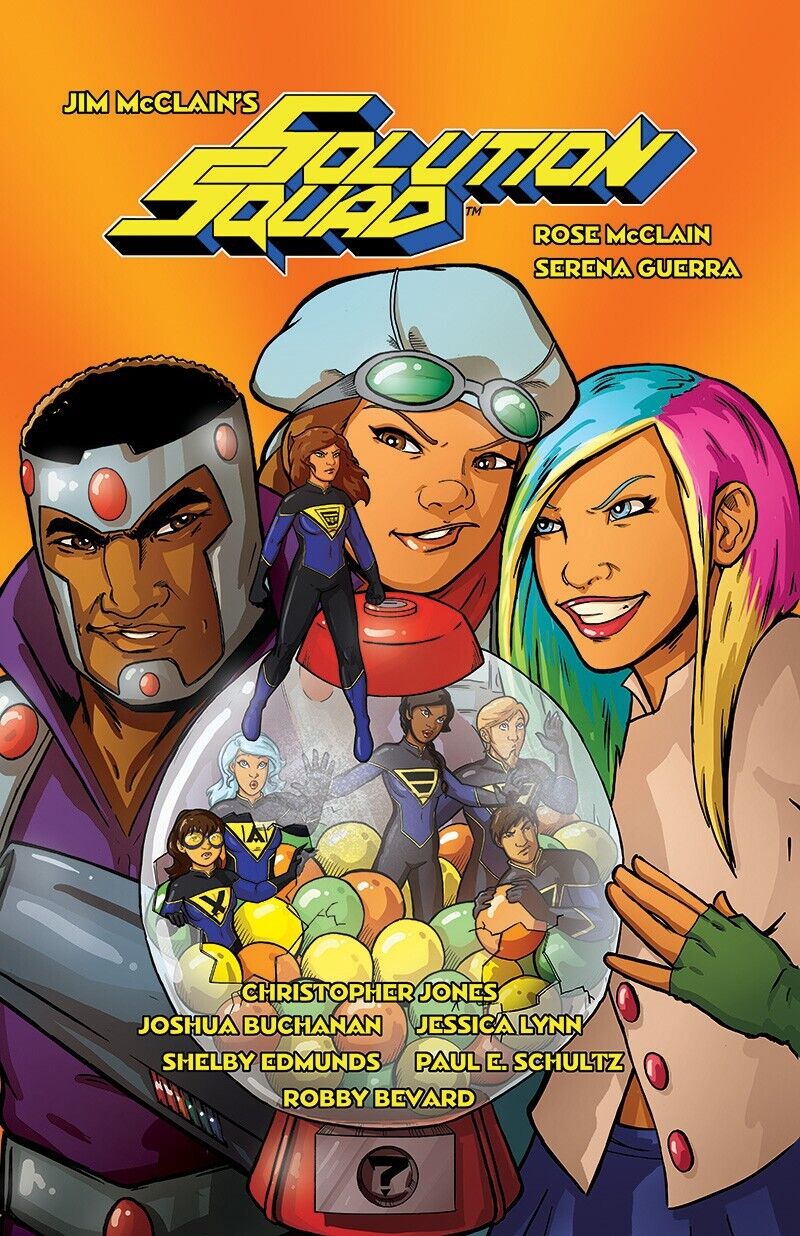
I love it so much that when I wrote an illustrated prose Solution Squad story for my graphic novel, I had a cover drawn by my friends Paul Schultz and Shelby Edmunds that is reminiscent of the cover of this book.
Cover of The Last Boy, by Paul Schultz and Shelby Edmunds
Looking back, much of my Solution Squad graphic novel was informed by these influential comics of my adolescence. And I wouldn’t have it any other way.
When my mother died a few years ago, we had been estranged for a long time. In fact, we were so estranged that I didn’t even know she had moved back to Michigan. To the best of my knowledge, she was living in a house that she and my late sister bought together in Utah. When I was given the unwanted task of taking care of her estate, I put the address in Google Maps, and was stunned. She hadn’t just moved back to Michigan; she had moved back to Hastings, Michigan, a town where we had lived for a number of years before and after she and my dad had split up. I honestly didn’t even need Google Maps when I saw which street she lived on. We had lived in two different houses not three blocks away from where her new house was.
We lived in one house on Grant Street in 1969, the year before I started kindergarten. It was a two-story house at the top of a hill overlooking the elementary school that I would someday attend, Northeastern. It was my parents’ second house. The first one was a tiny house right across from my Grandma and Grandpa McClain’s house in nearby Delton. This one was large enough that I could have my own room. It was red with white trim and a pretty house. I had happy memories there.
Me, riding the Batcycle down the sidewalk by Grant Street. I always wore a cape.
One of the great things about downtown Hastings back then was that they really went all out when decorating for the holidays. I loved Christmas. Heck, I still love Christmas, in part because of the memories made here. There were tinsel decorations, and trees, and lights everywhere you went, and there was a little hut that was open in the evenings where you could sit on Santa’s lap and tell him what you wanted for Christmas. Santa would give you a little candy cane when you were finished. I love candy canes and peppermint, really, to this day. My mom took me numerous times to tell Santa what I wanted for Christmas. She was making a list for the grandparents and for the aunts and uncles. I was the only grandchild on my dad’s side of the family. I was the oldest of only four on my mom’s side of the family. The problem was, I only ever asked Santa for one thing that year: a Meijer truck.
Now, if you’ve never heard of Meijer, it’s understandable. It was a regional grocery store chain started in Greenville, Michigan in 1934. It expanded over west Michigan fairly quickly, and one of our weekly things to do when my dad got paid was to get groceries at Meijer Thrifty Acres, as they billed it, in Battle Creek. Well, really it was a suburb called Urbandale, but you’ve probably at least heard of Battle Creek. One of Meijer’s charming qualities was that every store had Sandy, the electric horse that you could ride for a penny. Due to my dad’s influence, I was all about that cowboy life. I used to watch The Lone Ranger with him on Sunday mornings. It was his favorite show as a kid. So, every time we got groceries, I rode Sandy.
Sandy, still ready to ride for a penny!
Grocery shopping was such an integral part of our week, we always went out to eat before we went. Sometimes we would eat in Battle Creek at the Ritzee, sometimes back in Hastings at Dog ‘n Suds. It was always a place where we could eat in the car.
Look how fancy it was!
After dinner, we’d go get our groceries. I always looked forward to the cereal aisle, where I’d get to choose my cereal for the week. What was it going to be? Coco Puffs? King Vitaman? Ka-Boom? Quisp or Quake? Sugar Pops, maybe? On the way out, I’d get to ride Sandy, and the adventure concluded. My dad worked third shift, so that was most of our family time for the whole week. It’s no wonder those trips remain in my memory! On the way home, I would try to figure out what all the illuminated signs were for. I knew the Meijer sign well. It had a distinctive M shape, and started with the same letter and sound as McClain.
Meijer logo, 1966-1984
I would ask what each store sign was when they were all lit up, and my mom or dad would tell me. I started to memorize them so I could recognize them instantly. I played the same game with my Grandma McClain. And when I saw a Meijer truck, delivering a load to the grocery store, I knew that one for sure, every time! One one particular trip to get groceries, Meijer had their own Tonka truck for sale for Christmas. I loved Tonka trucks. I begged for the Meijer truck on every trip. My mom and dad would put me off. “Maybe for Christmas,” they’d always say.
So, back in Hastings when I went to visit Santa in his little shack (I actually called it an outhouse, because we had one at my grandparents’ cabin in northern Michigan), the only thing I would ask for was a Meijer truck. My mom must have been so frustrated. This kind of obsession is still one of my personality traits. Once I get the notion that I want something like that, I will get it, no matter what.
And lo and behold, what did I get for Christmas? That’s right, a Meijer truck.
I’ll be on the lookout for one of these at vintage toy shows. I think it would make a fine addition to my memorabilia shelves in my new office.
The entire idea of collecting comic books for monetary value was foreign to most kids in 1978. They were cheap reading material. But the appeal of the recent #1 issues from DC Comics, Firestorm and Steel the Indestructible Man was hard to pass up. So, when a #100 issue found its way to the stands, it was also a rare day, because most of the popular comics of the time from DC were in the three hundreds or even four hundreds. That’s not why I bought Showcase #100.
Showcase #100, art by Joe Staton
Showcase #100 got my attention because of the sheer number of characters on the front cover. I didn’t even care what the story was about, I just had to know what was going on to bring all these characters together. I knew the Flash, Green Lantern, Aquaman, the Atom, and Adam Strange from Justice League of America, and I knew the Spectre from various JLA/JSA crossovers and teaming up with Batman in Brave and the Bold. But then there was the Creeper, who I remembered from my early childhood, as well as the Hawk and the Dove! Way up there in the corner were the Metal Men. And look! Far in the back center were the Teen Titans! With this many characters, the adventure had to be serious.
The fabric of space and time seemed to be tearing as characters from every location and era seemed to be gathering at once in the same place. And then it was revealed inside that there were even more characters than depicted on the cover. Such an odd mishmash of heroes! Even the Inferior Five were involved. Well, as it happned, the Earth was being ripped from its orbit and being carried away, and it was up to this hodgepodge to fix it!
After a satisfying, though quick conclusion, everything was safe again, and it was only then that the secret of the colossal team-up was revealed. These were all characters who had either been introduced in the Showcase title, or had been revamped in Showcase! That’s when I remembered the Hawk and the Dove appeared in Showcase #75, which I had when I was very young, back when comics were just 12 cents.
Showcase #75, art by Steve Ditko
I had just gotten Showcase #94 the previous summer with the New Doom Patrol, so I kind of wondered what had happened to the title that it was only up in the 90s over ten years later. Still, I thought that was a pretty cool gimmick, and admired whoever thought of it. We didn’t use the term “meta” back then, but this was as “meta” as it got!
One of the last things I recall about living in Tustin was attending a three-day camp with the rest of my sixth grade class. We were staying overnight for two nights in cabins and had a number of activities that we could participate in. There were people swimming, canoeing, playing volleyball and basketball. One of the memorable parts of the camp was learning about drugs. We learned about marijuana, which I had literally never heard of before. We learned about the effects of alcohol. We learned about barbiturates. When they named several barbiturates, I piped up when I heard the name of one I knew. “I’ll allergic to phenobarbital!”
The camp presenter laughed and said, “I don’t think so. You’re probably thinking of something else.” But no, I am allergic to phenobarbital. I’ve been filling it out on forms my whole life. As it turns out, I was given phenobarbital to keep me docile after I had surgery when I was four years old. It did not work, as I had seizures because of it. And that’s how I know. Oh, those experimental 60s!
But the key memory I have of the camp defined pretty much my entire adult life, and I can’t believe I almost forgot to include it in my memories. I was playing basketball with a bunch of kids that I didn’t know. The sixth grades from three different elementary schools were all staying at the camp at the same time. I was no great shakes at basketball then. I had played organized basketball for exactly one practice before my stepfather forced me to quit in the winter of 1976. As mediocre as I was, I was still athletic and very tall. But as we played, I noticed a kid trying to shoot baskets off to the side of the basketball court. He was receiving a bunch of verbal abuse from some of the more talented kids on the court, and it really made me angry. I didn’t like seeing him get bullied like that. So, I stopped playing with the jerks and went over to play with that kid.
I don’t know what his disability was. I had no background for that. He was verbal, though impaired, but he clearly had severe coordination problems. He was having trouble even getting the ball up to the rim. I spent half an hour helping him to figure out how to make a basket. We got his hand directly behind the ball so he would have enough strength to get it up there, and then it was a matter of accuracy. Aiming for a spot on the backboard was the key. All the while, they boys were still taunting him…and me. I told the kid to ignore them and we kept going.
Finally, the ball went in. He cheered. And I’m not kidding, I thought he was going to cry. And then I thought I was going to cry. I had never felt anything like that in my whole life. It was like a flood of warmth overcame me. I put the ball back in his hands and he did it again. I had never seen such joy in a human being in my life, and I’m not sure I had felt that for myself, at least not in the same way. I had helped someone feel good about themselves. The kid thanked me over and over again, and I just nodded and said it was no big deal. Well, it turned out it was a very big deal for both of us. He had new confidence, and I had a new avocation. I wanted to teach people. I wanted to have that feeling again and again. It was addictive, and a far better addiction than any drug…even phenobarbital.