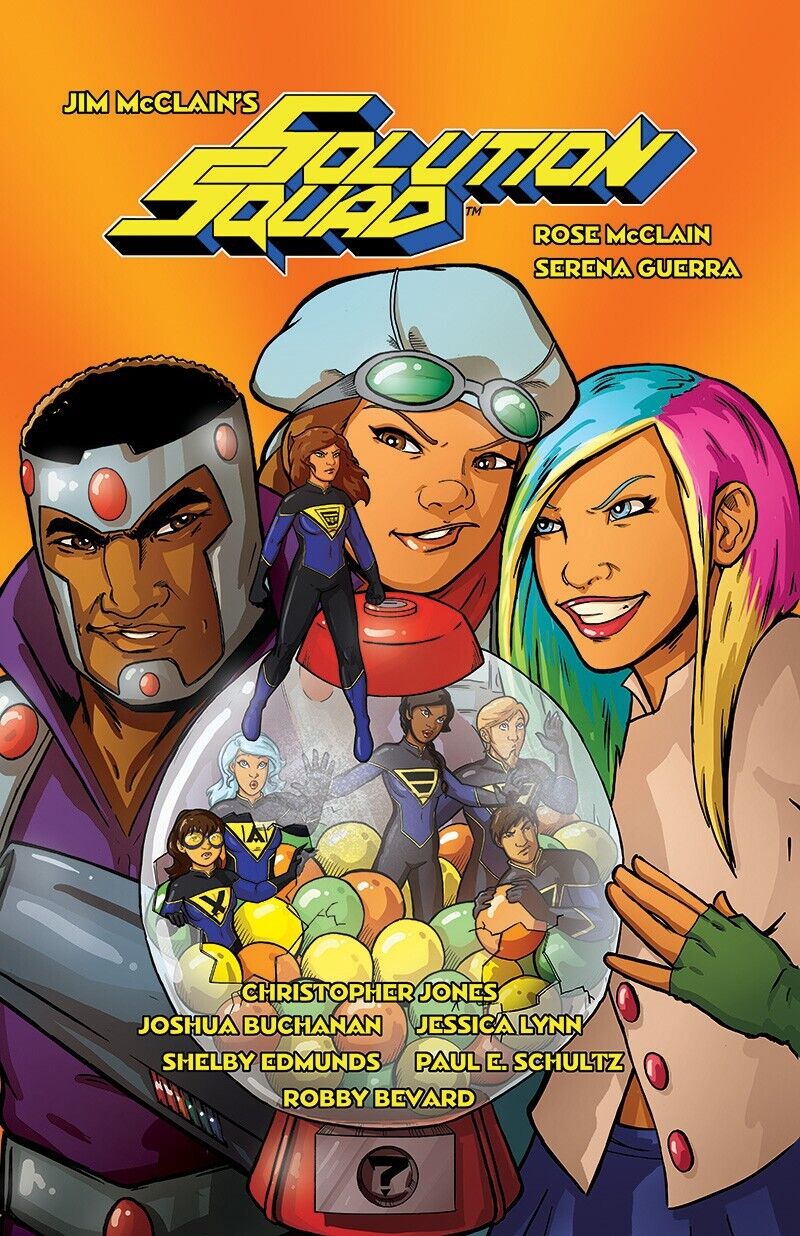
It’s hard to believe that 10 years have passed since the first time I set up as an artist at C2E2. It felt like a big gamble to even see if I could get in, but I did. The timing was so incredibly tight, but it all worked out in the end. The Solution Squad print comics had just come in two weeks earlier, and I felt like I was juggling a lot. I had applied for Solution Squad to be a part of the first open-invitation round of ComiXology’s Submit program, and again, to my astonishment, it was accepted! The online comic went live on April 24, just two days before the convention. It felt like everything was falling into place.
Using our contact at Rink Printing in South Bend, who had printed our comics, we had prints made up of Jordan’s final character designs, as well as professional business cards. I borrowed a display rack from our local comic shop, bought a navy blue tablecloth with criss-cross square patterns on it, like graph paper, and off we went. How many comics should I bring with me? I had no idea, so I just brought them all. They were still in the back of the minivan.
I have to admit, we were nervous when the morning started. The table was expensive, $425, which was not a small investment. Not a lot of interest or people stopping by. Jordan and I were just kind of soaking in the atmosphere of the place. C2E2, even in 2013 was a huge convention, with easily 50,000 people in the convention hall over the three days. Jordan got a few commissions, but I was getting more and more nervous by the minute. I was scheduled to speak at a panel at 12:45, moderated by Josh Elder, of the non-profit Reading With Pictures. I had met Josh the previous summer as he spoke at the Kids Read Comics event in Ann Arbor, Michigan, and he seemed very happy to meet an actual teacher interested in making educational comics. So, he invited me to be on the panel with him and Dr. Carol Tilley, the leading expert on Fredric Wertham, author of Seduction of the Innocent, and just a general expert in comics reading history, period. Just before 12:45, I grabbed my dress shirt and my favorite Batman tie, loaded up my laptop, and headed to the nearest restroom to change.
Josh Elder, Carol Tilley, and me at our panel, “Comics and the Common Core State Standards”
To my utter amazement, when I got there, the room was packed. There were easily more than 200 people in the room, maybe closer to 300. I had never spoken in front of that many people before, let alone teachers and professionals. I have to say, I was nervous about how a comic book teaching math would be perceived by actual teachers.
Josh opened the program, talking about how comics had helped him to learn to read as a child. He always cites Transformers #4 as the specific issue. And his tagline of “Hooked on comics worked for me” always gets a chuckle. That gave me a natural segue going into my part of the presentation because my hook into reading was Superboy #165, from…a few years before Josh’s comic. I started my presentation with a very bland, but effective opening slide:
My opening slide. Always good for a laugh from teachers!
As a teacher who had had far too many Power Points read to me in my career, I knew this would get a laugh, and it did. There was even a smattering of applause. I immediately went from near-shaking to relaxed. As I went through each slide, I introduced the audience to the characters I created and explained how I used them in class to introduce and teach math concepts. There were lots of murmurs from the crowd, and laughs exactly where I hoped they would land. And when I closed with the final slide, explaining that the Squad flew around in the Coordinate Plane, I thought the place was going to fall apart. There was raucous laughter; thunderous applause. And I got goosebumps. What just happened?
Still makes people laugh!
I listened to Carol’s presentation, and I never fail to learn something from her. But I was feeling just a rush of energy that made it hard to concentrate. After the whole panel ended, I was absolutely mobbed. People rushed up to shake my hand and tell me what a great thing Solution Squad was. One teacher said, “This is the most creative thing I’ve ever seen a teacher do!” and that nearly brought me to tears. Jordan, who was at the panel, escaped to get down to the convention table. They could read the writing on the wall. And when they got to the table, there was aleady a crowd. Talk about effective marketing! We had been sitting virtually alone for two hours on the first day of the convention and now we were swamped. After 20 minutes, I finally got back to the table myself, where there was a line of people waiting to talk to me.
One of the people waiting to talk to me was young fourth-year Chicago teacher Amy Hopkins, who bought an entire class set of 30 comics from me. Amy used Solution Squad in her class and even had her students write letters to me about how much they enjoyed the comic. Amy and I have been good friends ever since.
I made another friend that day in Bob Cassinelli, who worked at Gail Borden Public Library in Elgin Illinois. Bob invited Jordan and me to appear at his comic book show, Comic Book Mania, which we were pleased to do. I set up at that show for years afterward.
And I can never forget Bruce Nelson. Bruce was a teacher in Indianapolis who specialized in STEM education. Bruce told me about the Lilly Endowment Teacher Creativity Fellowship, a $10,000 fellowship for Indiana teachers that would allow me to fund my creative pursuits for a summer project. He told me all about how to apply. I did, and I won one of the 100 Fellowships. Less than a year later, I had a check for $10,000 in my hand. I guess the $425 convention table paid off!
After this convention and specifically my panel appearance, Josh Elder invited me to work with him and Reading With Pictures more closely as they tried to complete their work on The Graphic Textbook. I was brought in as a math consultant first, to work with de facto editor Tracy Edmunds, who became yet another good friend, then as a letterer for some of the anthology’s stories, and even an uncredited assistant editor of sorts, making corrections to some of the art in the book. I ended up designing the Teachers Guide using my very limited skills in InDesign, and co-editing that book along with Tracy Edmunds. Thanks to a shift in the Common Core State Standards, which moved prime numbers from a sixth grade standard down to a fourth grade standard, I was asked if my Solution Squad story could be included in the book, which I immediately agreed to. Later, this book would be bought by Andrews McMeel and published as Reading With Pictures: Comics That Make Kids Smarter, which got me my own author entry in the Library of Congress.
This one fateful event changed my life in myriad ways, leading to many more panel and convention appearances, inspiring me to travel all over the country talking about comics and education, making friends and earning accolades as I went. My life in comics was a cascade of new experiences, friendships, and uncountable rewards.
All told, we sold 83 copies of Solution Squad #1 that weekend, and even though those were respectable numbers for an unknown comic book about math heroes, I still remember posting on social media, “I feel like I’ve caught lightning in a bottle.” It was one of the best feelings of my entire life.
When my mother died a few years ago, we had been estranged for a long time. In fact, we were so estranged that I didn’t even know she had moved back to Michigan. To the best of my knowledge, she was living in a house that she and my late sister bought together in Utah. When I was given the unwanted task of taking care of her estate, I put the address in Google Maps, and was stunned. She hadn’t just moved back to Michigan; she had moved back to Hastings, Michigan, a town where we had lived for a number of years before and after she and my dad had split up. I honestly didn’t even need Google Maps when I saw which street she lived on. We had lived in two different houses not three blocks away from where her new house was.
We lived in one house on Grant Street in 1969, the year before I started kindergarten. It was a two-story house at the top of a hill overlooking the elementary school that I would someday attend, Northeastern. It was my parents’ second house. The first one was a tiny house right across from my Grandma and Grandpa McClain’s house in nearby Delton. This one was large enough that I could have my own room. It was red with white trim and a pretty house. I had happy memories there.
Me, riding the Batcycle down the sidewalk by Grant Street. I always wore a cape.
One of the great things about downtown Hastings back then was that they really went all out when decorating for the holidays. I loved Christmas. Heck, I still love Christmas, in part because of the memories made here. There were tinsel decorations, and trees, and lights everywhere you went, and there was a little hut that was open in the evenings where you could sit on Santa’s lap and tell him what you wanted for Christmas. Santa would give you a little candy cane when you were finished. I love candy canes and peppermint, really, to this day. My mom took me numerous times to tell Santa what I wanted for Christmas. She was making a list for the grandparents and for the aunts and uncles. I was the only grandchild on my dad’s side of the family. I was the oldest of only four on my mom’s side of the family. The problem was, I only ever asked Santa for one thing that year: a Meijer truck.
Now, if you’ve never heard of Meijer, it’s understandable. It was a regional grocery store chain started in Greenville, Michigan in 1934. It expanded over west Michigan fairly quickly, and one of our weekly things to do when my dad got paid was to get groceries at Meijer Thrifty Acres, as they billed it, in Battle Creek. Well, really it was a suburb called Urbandale, but you’ve probably at least heard of Battle Creek. One of Meijer’s charming qualities was that every store had Sandy, the electric horse that you could ride for a penny. Due to my dad’s influence, I was all about that cowboy life. I used to watch The Lone Ranger with him on Sunday mornings. It was his favorite show as a kid. So, every time we got groceries, I rode Sandy.
Sandy, still ready to ride for a penny!
Grocery shopping was such an integral part of our week, we always went out to eat before we went. Sometimes we would eat in Battle Creek at the Ritzee, sometimes back in Hastings at Dog ‘n Suds. It was always a place where we could eat in the car.
Look how fancy it was!
After dinner, we’d go get our groceries. I always looked forward to the cereal aisle, where I’d get to choose my cereal for the week. What was it going to be? Coco Puffs? King Vitaman? Ka-Boom? Quisp or Quake? Sugar Pops, maybe? On the way out, I’d get to ride Sandy, and the adventure concluded. My dad worked third shift, so that was most of our family time for the whole week. It’s no wonder those trips remain in my memory! On the way home, I would try to figure out what all the illuminated signs were for. I knew the Meijer sign well. It had a distinctive M shape, and started with the same letter and sound as McClain.
Meijer logo, 1966-1984
I would ask what each store sign was when they were all lit up, and my mom or dad would tell me. I started to memorize them so I could recognize them instantly. I played the same game with my Grandma McClain. And when I saw a Meijer truck, delivering a load to the grocery store, I knew that one for sure, every time! One one particular trip to get groceries, Meijer had their own Tonka truck for sale for Christmas. I loved Tonka trucks. I begged for the Meijer truck on every trip. My mom and dad would put me off. “Maybe for Christmas,” they’d always say.
So, back in Hastings when I went to visit Santa in his little shack (I actually called it an outhouse, because we had one at my grandparents’ cabin in northern Michigan), the only thing I would ask for was a Meijer truck. My mom must have been so frustrated. This kind of obsession is still one of my personality traits. Once I get the notion that I want something like that, I will get it, no matter what.
And lo and behold, what did I get for Christmas? That’s right, a Meijer truck.
I’ll be on the lookout for one of these at vintage toy shows. I think it would make a fine addition to my memorabilia shelves in my new office.
The entire idea of collecting comic books for monetary value was foreign to most kids in 1978. They were cheap reading material. But the appeal of the recent #1 issues from DC Comics, Firestorm and Steel the Indestructible Man was hard to pass up. So, when a #100 issue found its way to the stands, it was also a rare day, because most of the popular comics of the time from DC were in the three hundreds or even four hundreds. That’s not why I bought Showcase #100.
Showcase #100, art by Joe Staton
Showcase #100 got my attention because of the sheer number of characters on the front cover. I didn’t even care what the story was about, I just had to know what was going on to bring all these characters together. I knew the Flash, Green Lantern, Aquaman, the Atom, and Adam Strange from Justice League of America, and I knew the Spectre from various JLA/JSA crossovers and teaming up with Batman in Brave and the Bold. But then there was the Creeper, who I remembered from my early childhood, as well as the Hawk and the Dove! Way up there in the corner were the Metal Men. And look! Far in the back center were the Teen Titans! With this many characters, the adventure had to be serious.
The fabric of space and time seemed to be tearing as characters from every location and era seemed to be gathering at once in the same place. And then it was revealed inside that there were even more characters than depicted on the cover. Such an odd mishmash of heroes! Even the Inferior Five were involved. Well, as it happned, the Earth was being ripped from its orbit and being carried away, and it was up to this hodgepodge to fix it!
After a satisfying, though quick conclusion, everything was safe again, and it was only then that the secret of the colossal team-up was revealed. These were all characters who had either been introduced in the Showcase title, or had been revamped in Showcase! That’s when I remembered the Hawk and the Dove appeared in Showcase #75, which I had when I was very young, back when comics were just 12 cents.
Showcase #75, art by Steve Ditko
I had just gotten Showcase #94 the previous summer with the New Doom Patrol, so I kind of wondered what had happened to the title that it was only up in the 90s over ten years later. Still, I thought that was a pretty cool gimmick, and admired whoever thought of it. We didn’t use the term “meta” back then, but this was as “meta” as it got!
One of the last things I recall about living in Tustin was attending a three-day camp with the rest of my sixth grade class. We were staying overnight for two nights in cabins and had a number of activities that we could participate in. There were people swimming, canoeing, playing volleyball and basketball. One of the memorable parts of the camp was learning about drugs. We learned about marijuana, which I had literally never heard of before. We learned about the effects of alcohol. We learned about barbiturates. When they named several barbiturates, I piped up when I heard the name of one I knew. “I’ll allergic to phenobarbital!”
The camp presenter laughed and said, “I don’t think so. You’re probably thinking of something else.” But no, I am allergic to phenobarbital. I’ve been filling it out on forms my whole life. As it turns out, I was given phenobarbital to keep me docile after I had surgery when I was four years old. It did not work, as I had seizures because of it. And that’s how I know. Oh, those experimental 60s!
But the key memory I have of the camp defined pretty much my entire adult life, and I can’t believe I almost forgot to include it in my memories. I was playing basketball with a bunch of kids that I didn’t know. The sixth grades from three different elementary schools were all staying at the camp at the same time. I was no great shakes at basketball then. I had played organized basketball for exactly one practice before my stepfather forced me to quit in the winter of 1976. As mediocre as I was, I was still athletic and very tall. But as we played, I noticed a kid trying to shoot baskets off to the side of the basketball court. He was receiving a bunch of verbal abuse from some of the more talented kids on the court, and it really made me angry. I didn’t like seeing him get bullied like that. So, I stopped playing with the jerks and went over to play with that kid.
I don’t know what his disability was. I had no background for that. He was verbal, though impaired, but he clearly had severe coordination problems. He was having trouble even getting the ball up to the rim. I spent half an hour helping him to figure out how to make a basket. We got his hand directly behind the ball so he would have enough strength to get it up there, and then it was a matter of accuracy. Aiming for a spot on the backboard was the key. All the while, they boys were still taunting him…and me. I told the kid to ignore them and we kept going.
Finally, the ball went in. He cheered. And I’m not kidding, I thought he was going to cry. And then I thought I was going to cry. I had never felt anything like that in my whole life. It was like a flood of warmth overcame me. I put the ball back in his hands and he did it again. I had never seen such joy in a human being in my life, and I’m not sure I had felt that for myself, at least not in the same way. I had helped someone feel good about themselves. The kid thanked me over and over again, and I just nodded and said it was no big deal. Well, it turned out it was a very big deal for both of us. He had new confidence, and I had a new avocation. I wanted to teach people. I wanted to have that feeling again and again. It was addictive, and a far better addiction than any drug…even phenobarbital.
Following the massive success of Star Wars, magazines were keen on remembering movies of times past that were similar in theme and genre. Science fiction was for a time no longer simply the milieu of nerds. One of the first such magazines was Science Fantasy Film Classics, which debuted with this issue:
Science Fantasy Film Classics #1
Naturally, because Star Wars was on the cover, I asked my grandma to buy it for me, which she did. She loved how much I read about everything that interested me. But this particular magazine had something that caught my dad’s eye, too. It had a feature about Forbidden Planet, the 1956 science fiction version of Shakespeare’s The Tempest. He had seen Forbidden Planet when he was 12, so in a a way, it was very much his Star Wars. I had read the article, but didn’t think very much about it, because in 1978 there was no way to see a movie like Forbidden Planet unless it was shown on television, and 1956 movies were too old to be profitable in prime time. Cue the CBS Late Movie.
Back in those days, the CBS Late movie would come on following the news, up against Johnny Carson and The Tonight Show. They would fill a two-hour time slot with whatever content they had readily available. Reruns of McCloud back-to-back with another hour drama like Kojak, or MASH, followed by a 90-minute classic movie. So, imagine my surprise on Friday, January 6, when my dad roused me out of a deep sleep at midnight because, “JIMMER! FORBIDDEN PLANET IS ON!”
I was instantly awake. We had just talked about Forbidden Planet that week. Mind you, we were only able to watch it on our 9″ black and white TV, but it hardly mattered. As I watched the movie, enthralled, the C-57D floated through space similarly to the starship Enterprise. The links to the familiar didn’t end there. Here was Robby the Robot, whom I’d seen on Lost in Space. Chief Quinn was played by Richard Anderson, who I knew as Oscar Goldman. Police Woman’s Lt. Bill Crowley, Earl Holliman, was Cookie.
Earl Holliman as Cookie, with Robbie the Robot
Forbidden Planet was like the best episode of Star Trek ever. The C-57D is dispatched to determine the fate of the Bellerophon, a scientific research vessel that had been sent to Altair IV 20 years before. There, they find one original survivor, Dr. Morbius, and his young daughter, Altaira. The rest of the Bellerophon crew is dead, including Altaira’s mother. Morbius, the lone survivor, is not happy to see the crew of the C-57D, and wants them to simply go away. He has been studying the lost civilization of a race called the Krell, who harnessed the powers of the mind to create incredible scientific advances. Morbius himself has been able to created incredible technologies like Robbie the Robot, who acts as servant, manufacturer, and protector to Morbius and his daughter. When the captain, played by a very straight Leslie Nielsen, inform him that they are required to investigate, Morbius tries resisting them at every turn. However, he is foiled by his daughter Altaira, who has grown up without peers on Altair IV. She is very interested in the captain and his crew, and therein, a very Kirklike struggle begins.
I love this movie, and the more I saw it over the course of years, finally in color, then in digital widescreen format, I loved it even more every time. I picked up the novelization at a yard sale years later, and, as I always did, I read it cover to cover, trying to glean every last bit of information from it.
Perhaps most importantly, though, my dad and I bonded over something that we now had in common, and even though I was up until 2 AM, I got my full night’s sleep, waking up late. But I was dreaming of Altair IV.
Hot on the heels of the great treasury-size All-New Collector’s Edition #C-55 featuring the double covered Legion of Super-Heroes came what very well may be my favorite comic book of all time: All-New Collector’s Edition #C-56, Superman vs Muhammad Ali!
All-New Collector’s Edition C-56, Superman vs. Muhammad Ali
With another fantastic wraparound cover, this time by Neal Adams, Superman vs. Muhammad Ali sounded initially like a dumb idea. Of course Superman could easily beat Muhammad Ali in a fight–any fight. I had watched Muhammad Ali fight all through the 70s. I had seen virtually all of his title defenses and losses, including his loss to Leon Spinks on February 15 that year. So, by the time Superman vs. Muhammad Ali came out, Ali was no longer the champ. That diminished the power of the comic book not at all.
Now, Neal Adams was primarily known as a Batman artist. He had done lots and lots of Batman stories. But his Superman covers were just beyond compare. As much as I love Curt Swan’s artwork, when you bait-and-switch a Curt Swan story with a Neal Adams cover, that’s a pretty big shock.
Superman #233, art by Neal AdamsSuperman #317, art by Neal Adams
As soon as I opened the Superman vs. Muhammad Ali comic, it was different than any other Superman comic I had ever read. The opening double-page splash was just Clark Kent, Lois Land, and Jimmy Olsen walking down the street, yet it invited me to stare at it for several minutes. I’d never seen a street in a big city before, but it was easy to imagine that this is what one might look like. I almost felt worldly just taking all the details in.
Superman vs. Muhammad Ali pages 2-3. Art by Neal Adams
It doesn’t take long to get into the action, as the trio find Muhammad Ali shooting hoops with some local kids and naturally, an alien lands to challenge Ali to a fight against his champion. Because in the 1970s, this was not out of the ordinary at all. I loved comics then! When Ali refuses, the alien threatens Earth with destruction by firing two missiles at the planet. While Kent sneaks off to change to Superman, he rushes to the missiles, but finding that they are made of plasma and he passes right through them. By flying in circles at superspeed, Superman creates a wind tunnel powerful enough to affect the mass of the missiles, which then detonate in the ocean. The don’t detonate harmlessly, however, as a tidal wave is set into motion. Superman stops that by slamming his fists together to make a shockwave. At the same time, the aliens, called the Scrubb (unfortunately) have launched two more missiles, that Superman is just a fraction too slow to intercept.
The Scrubb missiles explode. Original coloring.
Now, all of this occurs in just the first dozen or so pages of a 72-page story! It was not a reprint. It was not a collection. This was something special. In effect, Superman challenges Ali for the right to fight against the Scrubb champion. But of course, things being equal, Superman would easily win. But it’s revealed that the Scrubb homeworld orbits a red sun, so Superman wouldn’t have any powers there anyway. Ali agrees to train Superman but they are given only a short time to manage this before they fight each other for the right to go up against Hun’Ya, the Scrubb fighter.
I’m not going to spoil the rest of the story because it really is a lot of fun. There are twists and turns and a pretty big surprise that fooled me as a 13-year old, and I wouldn’t want to ruin it for you. Trust me, you need to read this comic book. I promise you, it all makes sense in the end.
I studied every page of this comic book for the next year, and that’s not an exaggeration. By the time the next summer rolled around, I had my brother and sister record an audio version of it with me, using the tape recorder I had received for Christmas. You could tell that DC was gearing up toward the big event, and I started buying more Superman comics. Gary Grossman’s book, Superman: Serial to Cereal got a new printing, which I also bought. This was the first time I learned of the Fleischer Superman cartoons of the early 1940s. I had known about the radio show, but had no idea that there were Superman cartoons before 1966. I had also never seen a single episode of Adventures of Superman, the long-running TV show of my dad’s youth. The book explained that Superman had his own movie serials too!
I was born into Batmania, but clearly there had been more to Superman than had met my eye! It was at this point, even before Superman the Movie would be released in December, that my favorite fictional character was shifting from Batman to Superman.