“Welcome aboard the USS Challenger. I’m Captain Jeff Chamberlain. If you’ll step down off the transporter pads, we’ll begin our tour.
Captain Jeff Chamberlain, deck 3 corridor, USS Challenger
“Before we begin, I’d like to give you a little context about Challenger‘s mission. In just a short time, the USS Enterprise should conclude its five-year mission, the only Constitution-class starship out of the original 12 to do so. The other 11 starships succumbed to the dangers of space exploration. The USS Intrepid lost all hands to a giant space amoeba near Gamma 7A. The USS Constellation was destroyed while battling the so-called Doomsday Machine near L-374. The crew of the USS Exeter were killed while investigating Omega IV.
“The Hood, Potemkin, Excalibur, and Lexington were severely damaged due to the runaway M-5 computer. The Excalibur lost all hands and was set adrift, while the Lexington sustained severe damage to the engineering section but was able to continue in its mission. I served aboard the Lexington, and lost my best friend, Chief Engineer Harold Bichel. I continued serving under Commodore Wesley as the new chief engineer until the Lexington, too, met its demise to an aggressive D-7 Klingon cruiser near Beta-Delta XII. I was part of the surviving crew who had to stay alive on the class-L planet for 40 days until help arrived. My back was broken, and I can tell you that it was a long 40 days. That’s where Challenger comes in.”
“During my recovery at Starbase 1, I petitioned Starfleet to create a new kind of ship and mission. I had plenty of time flat on my back in the medical bay to work on my proposal. Using all the data from every ship in Starfleet to that point, I outlined and addressed the weaknesses that led to the destruction of the ships and the loss of their crews. At the same time, I examined the non-sentient parts of the Enterprise that have contributed to its singular survival. All of these traits have been incorporated by Admiral Krause at Tycho Starship Yards into one prototype: Challenger. Now, I understand that the Enterprise will be getting overhauled. I’ve seen some of the fancy new engine designs that they’re planning. I wanted none of that. I wanted the most reliable, dependable, tried and true technology that Starfleet had to offer. Challenger may be the first, last, and only ship of its kind. She’s a forward-looking throwback. She’s the size of a Constitution-class starship, but she only crews 204. I’m hoping you’ll be part of that crew. Each of you were recommended to me by your individual captains.
Comparison of Constitution-class and Challenger-class
Challenger‘s mission is not one of exploration. Challenger‘s mission is crisis and emergency response. You won’t find state-of-the-art astrophysics labs or stellar cartography decks onboard. You will find an entire deck of emergency crew quarters to house survivors and refugees. You will find large cargo holds to transport medicines and grains. And you will find an expansive shuttlecraft bay with no fewer than 16 N-type Javelin shuttlecraft for emergency evacuation and rescue.
“But I’m getting ahead of myself. Let’s start at the top. If you’ll follow me…”
Turbolift, USS Challenger
Shhkkkt.
“Computer; bridge.”
Shhkkkt.
Vrrrrrrr
“Such a satisfying sound, isn’t it? I understand that newer ships will have silent doors. I think that’s a shame. As you can see on the deck plans here, there are two turbolifts that go to the bridge. We typically use the main turbolift on the port side of the communications station. We reserve the secondary turbolift for emergencies. During my convalescence, I read too many incident reports of crew being trapped on the bridge after an incident with the sole turbolift being taken out of commission.
Shhkkkt.
Bridge, USS Challenger
“Captain on the bridge!”
“Shin, you’re the only one here.”
“Yes, Captain, except for the recruits you’re bringing on.”
“You have me there. Everyone, this is Lieutenant Shin Ch’tolnan, one of our tactical officers. It’s something new we’re trying out, separating the weapons systems from the conn. It’s enough to have to fly the ship under duress. It is thought that a dedicated weapons alcove would be more efficient. It’s one of the changes I didn’t come up with, but seems like a good idea.
“As you can see, there are two security stations, one for internal security and one for weapons systems. If necessary, they can be manned by two crewpersons. Shin knew we were coming because of an alert from his station. So, the port side of the bridge is typically manned by engineering or security officers. Communications is right behind the captain’s chair.”
Bridge, port stations, USS ChallengerLt. (j.g) Shin Ch’tolnan, junior tactical officer, USS ChallengerBridge station layout, USS ChallengerBridge, starboard stations, USS Challenger
“Over on the starboard side, we have Landing Party Monitoring, the medical station, and your typical science station. The interesting one is Landing Party Monitoring. You’ve probably noticed the device on my uniform that looks like a belt buckle. It’s called a Perscan, and it automatically feeds biometric data back to the ship via subspace link. It also helps maintain a transporter lock without relying on a communicator, which can be lost or taken away.
Perscan deviceMain bridge seen from viewscreen, USS Challenger
“And obviously, we have navigation, the helm, and the captain’s chair. Nobody really ever gets this view, since you have to stand in front of the viewscreen to get it. All right, take a good last look around and head to the main turbolift. You remember which one is the main lift, right?
“It’s the one on the port side. If you ever forget, it’s the one with the dedication plaque next to it.
Dedication plaque, USS Challenger
“Get back on that simulator, Shin. You need to get up to speed.”
“Aye, Captain.”
Isometric view of bridge, USS Challenger
Shhkkkt.
“Computer, deck three, aft.”
Vrrrrrrrr
Shhkkkt.
“Here we are, back on deck three. Deck two is taken up by a docking port. I was against that idea, because it provides easy access to the bridge for intruders, but I was overruled. Once we get underway, I’ll probably have the chief engineer weld it shut. Once we have a chief engineer, anyway.
Conference room, deck three aft, USS Challenger
“This is the conference room. On Constitution-class ships, the conference room was too far away from the bridge to be of practical use most times. In situations where solutions are not obvious, I always invite suggestions from my staff, and even debate, right up until I make my final decision.
“I like this room because it provides a good view of the nacelles. I may be a captain, but I’m still an engineer at heart.
Isometric view of conference room, USS Challenger
Shhkkkt.
“Also on deck three, we have transporter room one, where you beamed in. The Constitution-class ships had four transporter rooms. We have eight, and each one has eight pads and a cargo pad instead of the previous six-pad platforms. When we dedicate enough power to it, we can transport 80 people at the same time. That means we can move our entire crew in about two minutes if they’re standing by.”
Lt. Hal Bichel, security/communications officer, USS Challenger
“Ah, and Hal got here while we were gone to stock the armory. Everyone, this is Lieutentant Hal Bichel. Hal is a rare breed. She is both a communications and security officer. She had a double focus at the Academy.”
“What’s that, Commander? She has the same last name as my best friend? That’s not a coincidence. He was her father. Hal was with us on the Lexington when she was just a cadet. She’s also my goddaughter. Let’s–go ahead and continue our tour. I’ll see you later, Hal.”
Isometric view of Transporter Room 1, USS Challenger
Shhkkkt.
“Computer, deck five aft.”
Vrrrrrrrr
Shhkkkt.
Isometric view of Sick Bay, USS Challenger
“Pretty impressive, right? Here we are in the aft section of the middle of deck five, in the most heavily protected part of the ship. This is unchanged from the Constitution-class. None of the Sick Bays ever took direct hits in combat. This, however, is one of the most advanced medical facilities in Starfleet, only second to Starbase 1, though capacity is smaller, for obvious reasons. Sick Bay even has its own dedicated transporter room.
“Oh, and look who’s lurking about. This is Dr. Jenn Carmichael, my personal pain in the–”
Dr. Jenn Carmichael, nerve specialist, USS Challenger
“Don’t you say it, Captain. And speaking of backsides, have you done your physical therapy yet?”
“I’m getting to it. I’m a little busy, as you can see.”
“Captain, if you want to keep your command, you will do your physical therapy twice a day. I may not be the Chief Medical Officer, but I’m responsible for YOU.”
“Yes, Ma’am. Hey, everybody, remember how I told you that I broke my back? Well, turns out there was a little permanent nerve damage that went with it, which also happens to be my nickname for Lieutenant Carmichael. My sciatic nerve acts up from time to time. Good thing Starfleet made a new rule about landing parties. Captains pretty much stay in their chairs unless it’s absolutely necessary. And I have a really good chair.”
Office of the Chief Medical Officer, USS ChallengerMain bio bed room, USS ChallengerPhysical examination room, USS ChallengerLt Commander Brag bav Blav, trauma counselor, USS Challenger
“Oh, and look who it is! Dr. Brag bav Blav, everyone. Our trauma specialist. How’s it going, Doc?”
“How do you think it’s going, Captain? I just restocked my Saurian brandy. Again. I’m having Bichel put up a security force field on my display. These the new recruits?”
“Hopefully.”
“Well, I can’t wait ta get inside yer heads, kids.”
“Uh, okay, then, let’s continue, everyone.”
Shhkkkt.
“Computer, deck 16. aft.”
Vrrrrrrrrrrrrrrrrrrrrrrrrrrrrrrrrrrrr.
Shhkkkt.
“And here we are in my favorite place, Engineering. I saved the best for last.
“Over to the side is Auxiliary Control, where we can actually operate the ship if the bridge is compromised. And over here you see the warp core. What’s wrong, you’ve never seen anything like it? Well, my friend Woody, there, can tell you why. He’s the Assistant Chief Engineer. Lieutenant Wooderson?”
Lieutenant Chadwick “Woody” Wooderson, assistant chief engineer, USS Challenger
“All right, all right, all right! You must be the new recruits Cap’n has been trying to woo. This here is the fastest warp engine ever devised. Challenger has been rated for sustained speeds of warp factor eight, but we can push her up to warp nine if we have to. Of course, we can’t shoot when we go that fast, but you can’t have everything. She’s got some giddyup, and she purrs like a kitten at warp six. The only thing she don’t like is sittin’ still.”
Upper deck of engineering, USS ChallengerJeffries tube, USS Challenger
“Thanks, Woody. As you can see the warp core is installed vertically, requiring a second floor, which is new. And yes, we have a Jeffries tube for control access. No one likes to go in there, and hopefully no one will have to.
Isometric view of engineering, lower deck, USS ChallengerIsometric view of engineering, upper deck, USS Challenger
“Well, that pretty much concludes our little tour, unless you’re excited by cargo bays and crew quarters.
“If you’re still interested in serving aboard Challenger, I’m reviewing applications for the next several days. I look forward to reading yours.”
Credits:
Ship and shuttlecraft design by Bill Krause, @buckadmiral on Twitter, @admiralbuck on Instagram
Interiors by Craig Shoosmith, @tekknonerd on both Twitter and Tumblr
Spoilers for Season Two, Episodes 1-5 of Star Trek: Strange New Worlds follow. Go watch it!
Well, that was a whirlwind! I just finished watching the second season finale of Strange New Worlds season two, and I have to say, the whole thing went by much faster than I wanted it to. Using the modern format of 10-episode seasons made popular by the BBC and carried into the cable/streaming era here in the United States, SNW made the most of a limited format, carrying overarching character plots. Despite the episodic feel of the show, a deliberate departure after the slow, soap opera-like burn provided by its immediate predecessor, Star Trek: Discovery, we got satisfying character development arcs from many of the main characters.
In episode one, The Broken Circle, we pick right up where they left off last season, with Number One, Lt. Commander Una Chin-Riley, in Federation custody for lying about her species on her Starfleet application, which takes Pike right off the screen for the season opener, which I thought was an odd choice. This leaves Spock in command to answer a call from La’an, who took a leave to find Newt’s–er, Oriana’s parents from season one, episode nine. Against Admiral April’s orders, he steals the Enterprise for the very first time (see many other episodes of Star Trek for reference) and goes to her aid. We also get a brand-new chief Engineer in Carol Kane’s eccentric Pelia, and a dark backstory for both Chapel and M’Benga, who relive a little of their war experiences as they reveal a Klingon plot to restart the recent war. Spock ends up being a successful diplomat with the Klingons due to his willingness to drink Bloodwine. Spock is obviously still afflicted by emotions that he lost control of in S01: E09. M’Benga gives him the famous Vulcan Lyre to help deal with his overwhelming emotions, especially in regards to Christine Chapel. That was a lot to unpack for one episode! No wonder they sent Pike off-screen!
The second episode, Ad Astra Per Aspera, gives us a fantastic trial story, which is one of Star Trek’s true strengths. Through the years, there have been a number of great ones, from TOS’s Court Martial to TNG’s The Measure of a Man. This one is just as good. We get a healthy dose of Number One’s backstory, with the difficulty of an Illyrian trying to live within the Federation. It’s nothing short of inspiring. We also get to see Captain Pike’s sometime girlfriend, Captain Batel, back to prosecute the case. This lays groundwork for their relationship for the rest of the season as well. But one of the things that Star Trek does best is to hide modern issues under the veneer of science fiction. This episode was all about civil rights and identity politics and was well done. And just pencil Yetide Badaki in for an Emmy for best guest performance in a drama. The only thing that kind of tripped me up about this episode was wondering why Captain Batel was a prosecutor working for the JAG office when she’s a starship captain, in command of the Cayuga. She even refers to her “boss,” Vice Admiral Basalk, a Vulcan with a mean streak.
Then, in the third episode, Tomorrow and Tomorrow and Tomorrow, we get thrown for an entire loop, with a seemingly random time travel episode featuring La’an Noonien-Singh and her new boyfriend, Captain James T. Kirk?? What? La’an encounters a time traveler, who puts her on a path to another timeline where there’s no Federation because of an event in the 21st century. She and alternate timeline Kirk do the buddy cop thing and are whisked off to what Kirk thinks is New York City. It’s actually Toronto, which is hilarious because Toronto often stands in for New York in television. After the trademark Star Trek bit where local clothing has to be procured, Kirk gets them some operating capital by hustling chess. I love this particular bit, because so often Kirk is relegated to a horny frat boy in today’s thinking. But TOS first season Kirk was a master strategist, and beat Spock at three-dimensional chess, so this was a great callback to his original depiction in TOS. As with so many time travel stories, they are confronted by whether or not to kill Hitler, or in this case, Khan Noonien-Singh, La’an’s ancestor and Kirk’s deadliest enemy (in the future). In the process of investigating the source of a bridge explosion, they need ground transportation, and this Kirk shows his aptitude for driving cars is far superior to his prime timeline counterpart. The kicker is, though, that La’an falls in love with alternate timeline Kirk. She finally lets her very tightly-wound hair down a little, but he’s killed. La’an spares Khan, who by Star Trek history, should have by now already taken over a quarter of the world, but due to Romulan and other time-travelling interference, the timeline has been officially altered. The timeline is restored, but La’an is forever changed, and according to regulations, is forbidden to talk about it. La’an contacts the James Kirk in her timeline under the pretense that she’s checking on his brother Sam, which leads to some great stuff down the road.
The fourth episode, Among the Lotus Eaters, requires an aside. This title is so reminiscent of TOS, it’s just perfect. It’s metaphorical, and has no actual literal connection to the episode. It does have a literary connection, and that’s something the original series did to the extreme. A nice touch. Pike takes a step back from Batel just as she is refused a promotion, blowback from her weak prosecution of Una. Terrible timing on his part. The Enterprise returns to Rigel VII, the very mission Pike describes to Phillip Boyce in the beginning of The Cage, the first TOS pilot. He goes into more detail about the people lost on the mission here, and chooses a small landing party, including the doctor. M’Benga is a little miffed because he was chosen for his combat skills. Starfleet has spotted a delta shape in a garden using photography, since the atmosphere of the planet prevents scanning. At the last second, Ortegas, who was jumping at the chance to fly a shuttlecraft down, finally getting to be on the landing party, has to remain behind to fly the Enterpise on a complicated course. When the landing party arrives, under cover, they are taken captive. The supposed bronze-age society is armed with phaser rifles. Turns out that Pike’s yeoman from five years ago, Zac, is alive and well, and ruling the people. He punishes Pike and company by deliberately exposing them to the planet’s radiation’s terrible effects, where they lose their memories every night. That’s where the title comes from in Greek mythology. With the radiation affecting the ship as well as the landing party, everyone is in danger, especially La’an, who is sliced open while defending Pike.
When M’Benga and La’an recover their memories after Pike overthrows Zac, the two most traumatized members of the crew realize that the short respite, thanks to not remembering, could be pleasant. In the end, Pike and Batel realize that very few people could understand each other the way they do, and they kiss and make up.
After four very serious episodes, the fifth gives us Vulcan highjinks again, like last season’s Spock Amok. I like Vulcan shenanigans. Charades delves into Spock’s struggle with the emotions released in S01:E09 to the point where, on the eve of meeting T’Pring’s parents, he is involved in a shuttle accident and an alien life force transmutes his entire genome into that of a human. Yes, when he wakes up, the ears are round. Now, I want to pause here a minute to talk about something very serious: Spock’s sideburns.
Spock’s sideburns were a mess during the entire first season. They were worse on Discovery when he finally shaved off his beard, but all through the first season of SNW, they struggled to get it right. It’s been great during the second season!
Trial and Error
In Charades, Spock and Chapel are still dancing around one another, feeling awkward about their obvious relationship. To make matters worse, Chapel is applying for a Vulcan fellowship, studying with Roger Korby, whom we know is to be engaged to Christine. It’s part of her backstory, revealed in the TOS episode, What Are Little Girls Made Of? That makes us, the viewers, quite uncomfortable if we’re routing for Spockel–Chock? Whatever their merging would be called. Due to a shuttle accident, Spock is injured, then healed by an alien life force. Unfortunately, the source code they use to rebuild him was based on Chapel, who is completely human. Spock wakes up fully human and then the fun begins! Spock’s mother shows up in anticipation of Spock’s and T’Pring’s engagement dinner. She can tell immediately something is wrong. When they try to hide it, it’s very difficult for Spock to adapt. He almost strangles Sam Kirk in a meeting when Sam leaves a mess in front of him on a table. In the meantime, Chapel arranges for Ortegas and Uhura to travel adjacent to the anomaly that caused the crash, where they deal with aliens who I would call the Customer Servicians. They speak like the worst customer service people imagininable. In the course of Christine’s interaction with the Customer Servicians, she is forced to admit that she has feelings for Spock, admitting to a serious affection that she has had difficulty expressing for anyone for the entirety of the series. This character growth empowers her later when the Vulcan Science Academy turns her application for the fellowship down. During the engagement dinner, we meet T’Pring’s parents, and they are the most human Vulcans ever. T’Pril is an overbearing stereotype of a mother, and Sevek is the beaten-down husband whose testicles are being stored in a drawer. It is hilarious to witness the interplay between two Vulcans who are more human than Spock despite their full-blooded genomes. By the end of the episode, T’Pring has broken off the engagement with Spock, who reveals his temporary human nature to the in-laws to honor his mother, whom T’Pril has insulted continually since her arrival on board. This gives Spock and Chapel the opportunity to explore their feelings for one another, a tension that will be felt for the rest of the season.
Learning to read in the 1960s with Batman comics and the Batman TV show, it’s small wonder that I identified with Robin, the Boy Wonder. Always at Batman’s side, Robin gave kids, boys especially, someone to project themselves onto. Wouldn’t it be cool to be Batman’s sidekick? To ride along in the Batmobile? Robin was portrayed as about 16 on the Batman TV show, but in the comics by 1969, he was going off to college, so mark him down as 18 years old. He got aged up just a bit so that Batman would have darker solo adventures. He was still around 18-19 years old in comics in 1980, when the New Teen Titans got started. Time passed oddly in the DC universe. Yet, still, he led a whole superhero team at a pretty young age and had a lot more responisbility than most kids his age. When Marv Wolfman and George Pérez matured him for their book, it was time for a new Robin to be at Batman’s side. Dick Grayson abandoned his Robin identity in New Teen Titans #39, which I bought on my very first visit to a comic book store, mentioned here.
This was an exciting time to be reading The New Teen Titans. Longtime readers had been introduced to their newest member, Terra, and many fans thought she was just great. But when it was revealed that she was actually a spy working for Deathstroke, the Terminator, well, the wheels were about to come off the wagon. Suddenly, Dick Grayson discovered that his entire team had been ambused and were missing, and he was fresh out of yellow capes. By summer, the conclusion of “The Judas Contract” storyline was about to conclude, and Dick Grayson needed a new costumed identity.
So, after 44 years of being Robin, Dick Grayson became Nightwing. Now, before we get too far, here, I just want to point out that many barbs have been thrown toward this costume as somehow being inspired by disco because it has a raised collar. Uh, no, you mooks out there. It was inspired by the circus. You know, like Deadman? The other superhero in a circus costume?
Dick Grayson, having been a circus performer, obviously went back to his history to pull out that costume design. It was 1984, for crying out loud. Disco was gone.
Anyway, the comic where this transformation took place, Tales of the Teen Titans #44, was published in July 1984. I had just finished my freshman year of college, the second semester of which being much more successful and enjoyable for me. I had a steady girlfriend whom I had started dating in February, and I was down in Kalamazoo visiting her, when this comic book came out. But I also had a rare opportunity. My brother and sister were also in southwestern Michigan, with my mother and stepfather. They were staying couple of towns over at my stepfather’s parents’ house. I volunteered to come over and get them, and take them to the movies. My mother agreed. So, my girlfriend and I drove over to pick them up. Let’s see, I was 19 at the time (the same age as Nightwing), so my brother would have been 13 and my sister, 12. I took them to see what every kid that age should have seen that weekend: Indiana Jones and the Temple of Doom. Despite the more, uh, terrifying aspects of the Raiders prequel, they had fun and I had the unique feeling of being a true older brother, taking my younger siblings to the movies in the summertime, something I hadn’t really gotten to do, living apart from them as I did.
I enjoyed the Nightwing character, especially the part where Grayson was honoring Superman’s Kryptonian heritage as well. For many, many years of World’s Finest, the Batman-Superman teamup comic, Robin worked closely with both men, and I thought it was a nice touch to make a callback to that time. Nightwing was originally a costumed identity that Superman took on in the bottled city of Kandor, naming himself after a Kryptonian bird. Jimmy Olsen, of course, was his Robin, taking on the name Flamebird.
From Superman #158
Unbelievably, Dick Grayson has been Nightwing now for 39 years, almost as long as he was Robin. There have been some, let’s say, unfortunate choices along the way. The mullet, the ponytail, both a few years after they had been in style, for example. Having him be shot in the head and becoming an amnesiac, leaving a scar that looks like his symbol? That was rough. But more recently, the character has been given a new life, using his inhertiance to make life in his city better than perhaps Batman ever could. It’s good stuff.
It’s Comic-Con week again, and I’m preparing myself to see people hating on Comic-Con because “it’s not about comics anymore,” and I’m preparing to see people boast about not being there, because of some hipster sense that they’re too cool or not cool enough to go. You can take your pick there. You can see people who are hyped for Hall H and people who are offended that people attend things in Hall H. And I’m already seeing people who are enthusiastically promoting their own appearances and panels that they’re doing.
Here’s my take:
Comic-Con is exactly what you make of it. I’ve been to it three times, the last two times as a professional. And each time, I’ve found exactly what I was looking for. You want comics? There are a ton of creators there that don’t generally appear in the midwest. There are booths and booths and booths of new comics, old comics, original art, supplies, and anything else you could ever need for the hobby of collecting comics. There are multiple panels going on simultaneously, with information being given out by experts on everything in the field. I was privileged to participate in three of them in my pro days, which if you haven’t put it together yet, are over.
My favorite Comic-Con experiences came as surprises, like the first time I went. Back in 2004, my wife and I visited her sister and her husband when they lived in San Francisco. My wife had asked me if there was anything else I wanted to do in California during the time we were scheduled to be there. I joked, “Well, Comic-Con is going on that week…” She laughed it off and nothing more was said about it. It was just a pipe dream. As it turned out, my brother-in-law was actually going to be away from home for part of the week for that very reason. I was jealous. He was working for Industrial Light and Magic at the time, and was actually working on Star Wars Episode III. He arranged a visit to Skywalker Ranch for us, and even snuck me into ILM itself, which was against the rules. It wasn’t in the Presidio back then, but in a strip mall across from a Circuit City in a completely unmarked building. Super cool. When it came time to say goodbye to him so he could head to the airport, my wife told me to pack an overnight bag. I didn’t understand. She said, “You’re going with him.” Without my knowledge, they had planned the whole thing from the beginning!
We caught our plane at 6 AM, landed in Los Angeles at 7:30 AM, and Jeremy rented a convertible to drive the rest of the way down to San Diego. We got there, found a hotel (those were the days) and hopped a bicycle cab to the convention center. Jeremy was an industry pro, and registration was not quite as stringent as it is now, and he got us passes for two days based on his credentials. I was in heaven. The first thing I did was, of course, say hello to all the people I knew in Artist Alley. Jeremy was impressed that I seemed to know everyone, and that they knew me. It wasn’t quite that extensive, but it was a lot. Then he introduced me to someone he worked with at Blur Studios, Chuck Wojtkiewicz. I sputtered, “You drew Sultry Teenage Super-Foxes!” I thought poor Chuck was going to crawl under his table. He had also drawn Justice League of America for a bit, but I mean, who’s going to remember that? I got to meet Chris Claremont, writer of my favorite X-Men comics, and I bought a hardcover of that book for him to sign. But the key person I was thrilled to meet was Brent Eric Anderson.
Anderson, who drew my favorite comic book series of all time, Astro City, was all by himself with no line. I gushed like a fanboy and told him that I had several of his original pages from Astro City. I asked him for a sketch of The Confessor and Altar Boy, and now that sketch sits right in front of me in a place of honor on my art wall in my office.
Jeremy met with other Blur Studios alumni while he was there, including the owner, Tim Miller, who took his entire group, including me, to lunch. Now, if the name Tim Miller sounds familiar, it should. He directed Deadpool. So yes, thanks to Jeremy, I get to say that I was taken to lunch by the director of Deadpool. And if Chuck Wojtkiewicz’s name didn’t sound familiar before, it’s only because he was an unsung hero working on Deadpool. Chuck storyboarded the entire “12 Bullets” sequence of that movie.
What a trip!
I didn’t get to go to Comic-Con again for several years. The experience had been a little overwhelming, to say the least. The convention had dwarfed all the others I had attended. But it only got bigger as time went on. The next time I went was in 2016, when I was working on Solution Squad. I applied to present a panel there, and was accepted. I participated in another panel, as well. And as an all-ages author participating in panels, I was invited to the Scholastic party being held on the rooftop of a nearby hotel. It also served as a release party for Raina Telgemeier’s Ghosts graphic novel. If you don’t know Raina’s name, she is the queen of American graphic novels. She is also one of the most down-to-earth people you’ll ever meet. This whole experience was another surprise! I got to pitch Solution Squad to an editor there, but it wasn’t something they were publishing at the time. I was disappointed, but not too surprised about that.
I received one of the gift bags that they had set aside at the party, and it contained an uncorrected proof copy of the book. My daughter, who was 10 years old at the time, was a near-celebrity for having a copy before any of her friends did. I had fun just hanging out with my dear friend Tracy Edmunds, with whom I worked on so many projects. I had lunch with Tracy and her daughter Shelby, who I was meeting for the first time. Shelby went on to color some stories for me. She’s very talented!
Another pleasant surprise occurred when I got to meet my favorite Superman writer, Elliot S! Maggin, whom I didn’t even know was going to be at the convention. He was there to receive the Bill Finger Award, which is given to writers who have not previously been recognized enough for their work. Elliot was not only my favorite Superman comic book writer, but had also authored two Superman prose novels that meant a lot to me (and still do, actually) when I was young. I was thrilled at the opportunity to meet him.
Me with Elliot S! Maggin, Comic-Con 2016
I got teased about wearing a Batman shirt when I took a photo with him. If I’d known he was going to be there, I would have worn a Superman shirt!
At this same convention, I got to meet Steven E. Gordon, who had long been a Facebook friend, but also created the cover for my first comic book! Steve was the character designer for X-Men Evolution, one of my favorite cartoons.
The main cast of X-Men Evolution
When I initially started pitching Solution Squad, I described it as “X-men Evolution meets Numbers.” So it seemed natural to ask him to do the cover of my first comic book.
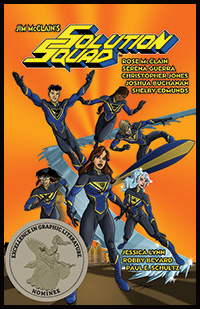
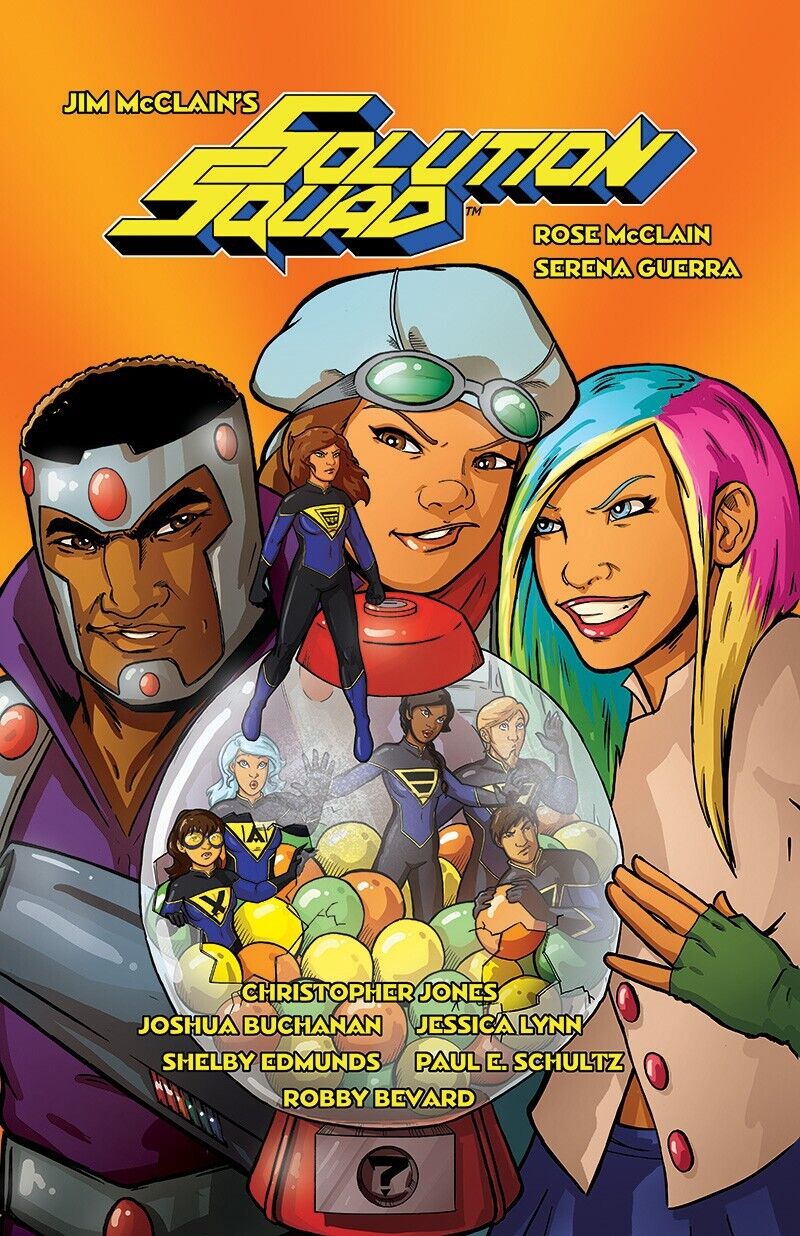
The cover of Solution Squad #1, drawn by Steven E. Gordon and colored by Eric Gordon
It was also a nice time seeing friends from the old Clobberin’ Times amateur press alliance, a publication I belonged to 30 years ago.
Me with my buddy Tim Watts, before he went all grey!
The last time I went to Comic-Con was in 2019, a year ahead of the pandemic. Out of the three panels I submitted, the one I was least prepared to give was accepted. I went with my two buddies, Scott Wiles and Jon Loftus. I did have a good time, but there was definitely a damper on my enjoyment. At that point in my comics career, I was beat. I was tired of doing conventions. I was tired of travel, and I was tired of pretty much everything to do with it, especially the crowds.
The line to get into the main convention floor, 2019
That said, I made the most of the convention. It’s often said, “Comic-Con isn’t about comics anymore.” Well, it is if you make it about comics. I spent the majority of my time among the comics dealers in the vendor room, and found a ton of comics I wanted. There were comics, old toys, original art, you name it. It’s all there if you look for it. I got to see my friends Chuck, Steven, and Elliot again. I got to pick up merch from my friend Katie Cook, supporting her web comic Nothing Special, of which my daughter is a huge fan.
Katie Cook is always easy to find at a convention. Look for the longest line!
I also made a point to pick up con-exclusive merchandise that I could re-sell later at a premium to help pay for my trip.
Never in my life did I imagine there would be an action figure set like this!Thanks to Tim Watts and Aaron Storck for being at my panel!
Again, seeing friends from the Clobberin’ Times was great. Tim Watts and Aaron Storck were on hand for my panel. It’s always great catching up.
When I returned home, I was exhausted. Of course, that was the last convention before the pandemic happened, so I’m sure it hasn’t been the same. I know I have no desire to go again. The pandemic changed me permanently. I don’t like traveling by air anymore, and I don’t like large crowds at all. But I sure enjoyed the times I went and I don’t regret any of those trips!
It’s funny how the simplest thing can trigger strong memories. It happened to me again today. I went outside to the front of the garage to grill a couple of hamburgers and it started to rain. The drops were slow, but pretty big, and next thing I knew, it was a soaking torrent. So much for grilling!
I went back inside, and rather than dig a George Foreman grill out of storage, I just took out a frying pan and turned a stovetop burner on. Just as soon as I dropped the patties in and they started sizzling, the combination of sound and smell transported me back to the summer of 1986. I was living with five young college women on West Dutton Street in downtown Kalamazoo. It was what they called the “student ghetto” back then. They were all friends of my fiancee at the time, and I was subletting my fiancee’s room for the summer while she moved back home with her parents. I just needed a place to stay between semesters at school, because I lived in the dorm all four years. Believe it or not, it was cheaper for me to do so because of my financial aid. The house was, shall we say, not nice. I spent a good many evenings catching mice with homemade traps made out of grocery bags and string.
I was broke and hungry for the first half of the summer. I was taking a summer class up on main campus, and I needed to commute every other day to get there. I bought a bike to help with the commute. My brother had destroyed my beloved 10-speed when I was gone on vacation one year while I was away, so I had to buy a new bike. I bought a new Huffy for about $100 at Toys R Us, where I worked, and I rode that up to campus and back. I assembled it myself to save money, and while doing so, I twisted off the nut that held the wire for the brake calipers in place. It was cheap, soft metal, and it just snapped. I took the bike back. Rather than just giving me a new nut, they replaced the entire bike, and I had to put another bike together all over again. I was very careful with the tightening that time.
I rode the Huffy up to campus on Mondays and Wednesdays, and I worked part-time at Toys R Us on Tuesdays and Thursdays, and some Saturdays. My housemates were generous enough to give me rides to work, because no one wanted me riding a bike down the busiest street in Kalamazoo at 9:30 at night. I was only working 20 hours a week at minimum wage, but that was more than enough to pay my share of the rent and to pitch in for food. My request each week was two pounds of ground beef and a pack of hamburger buns. And my caloric intake was a bowl of community cereal with milk in the morning and about a 1/3-pound hamburger each afternoon. One of my housemates taught me how to season and fry a hamburger, and I was good to go.
Not a lot of food for a 21-year-old, but it was enough to sustain me. I had the occasional box of Meijer brand macaroni and cheese. I had grown up eating that, after all.
I spent most of my time in the house reading, because I was stupid enough to take an English class on 20th century American authors. The books were long and boring. The other time I spent drawing, which paid off for me in an unexpected way. When the young women saw that I could draw, one asked me to draw a sketch of her. I had drawn from life in my freshman year, and I wasn’t bad at it, so I agreed. What I didn’t realize is that she wanted me to draw her in her underwear for her boyfriend. I tried to be professional about it. The model I had drawn in my studio art class had been nude, so I didn’t act like a total dork, but I was still nervous because this was someone I knew. When the rest of the ladies saw the result, I suddenly had a steady stream of customers. I guess that’s really the right word, because I exchanged my art skills for free rides to work. So, that made for a truly interesting summer, that’s for sure. I’m not sure how their boyfriends took having me see their girlfriends in their underwear, but they never mentioned it to me. Who knows, maybe the sketches weren’t really for them? The exposure didn’t only go one way, as I got walked in on while showering more than once, and we didn’t have a shower curtain.
At Toys R Us, I truly was in my element. I quickly became known as the “King of the 300 Aisle.” The 300 aisle was where the action figures and Barbies were stocked. I knew every toy line and I knew them well. Because there were few superhero shows at the time (can you imagine?), I watched the various cartoons that went with them. There were Transformers (Generation 1), GI Joe, Masters of the Universe, Warlord, Dungeons and Dragons, Chuck Norris Karate Kommandos, Thundercats, Silverhawks, Super Powers, Secret Wars, Star Wars Droids, and there were even some carded Mego Hulks still on the pegs, most of them with at least one broken leg.
A common sight back then…
I collected the Super Powers line myself, and had a complete set of every figure released, except one. I had never seen a Cyborg figure myself. I opened every case of Super Powers that came in that summer and still never saw a Cyborg figure. I started to suspect that it wasn’t real.
Someone got one somewhere, but it wasn’t Kalamazoo, Michigan!
This was where I first started dabbling with toy scalping. On certain weekends I was helping my friend Marc Newman do comic book conventions. Marc had awful night vision, and in exchange for comics and pizza, I drove him to and from cons, also providing raw muscle. Back then, I thought nothing of carrying two long boxes at the same time. Boy, those were the days! At one such convention, I noticed that two GI Joe figures, Snake Eyes and Storm Shadow, were selling for $20 apiece. I didn’t understand that, because I was still shelving them regularly in my evening job. The dealer said that they were hard to find in the wild, as he put it. I asked Marc if it would be okay if I grabbed a couple from work and put them up for sale at his table. he said he didn’t mind at all. So, the next week, I went to the back of the store, opened up two fresh cases of GI Joe figures, and spent $16 of my meager paycheck to buy two Snake Eyes figures and two Storm Shadows.
And sure enough, that weekend, I sold them for a total of $80! Bear in mind, I was making minimum wage, $3.35 an hour back then, so the $64 I earned in profit was the equivalent of 19 hours of labor! I couldn’t believe it. I did that for the rest of the summer. At least I could finally eat better!
The only drawback to working at Toys R Us was that I had to walk past the animatronic Teddy Ruxpin teddy bear. It had a motion sensor, so every time anyone walked past it, it began to sing, “Come Dream With Me Toniiiiiight.” And since it was on an endcap, at least 50 times a day, I heard that stupid song until I finally learned how to disconnect the motion sensor.
Bite me, Teddy
The summer passed pretty slowly, and things got heated for a bit, both literally and figuratively. We had no air conditioning. We all walked around in various states of undress as it got into the 90s. That, combined with not seeing our significant others on a regular basis due to crazy work schedules led to a great deal of frustration. I remember one night when we all sat in the living room, reading aloud stories from Penthouse Forum. I think we were all pretty much feeling it at that point, but certain people were sending pretty clear signals to me and some of the other ladies got jealous, even though I wasn’t responding to them. That caused friction among three of the five for some time.
Another point of tempation came when we got robbed. While we were all out of the house, someone broke in through the back French doors, and took the television, the stereo, and…the Trivial Pursuit game. Honestly of all those things, the Trivial Pursuit game hit us the hardest because we didn’t have cable anyway. We played the board game more than we watched the TV. But that sense of violation made us feel insecure. I was invited to sleep with two of my housemates for a week after that. No funny business, mind you, just sleep. Yes, the thought did cross my mind. I was 21 years old and had seen every one of them in their underwear. I have a feeling I could have, but I was engaged at the time, and remained faithful.
I ended up with a B in the summer reading class, and I don’t think I even read the last two books on the list. But I knew I could BS with the best of them and I did on the written final exam, and at the end of summer, I was almost grateful that it was time for me to move back into the dorm. At least I would eat better. All of my possessions put together fit into the trunk of one car. But what to do with my bike? Well, I’m not especially proud of this, but coincidentally, I tightened the brake caliper nut too hard (it was always coming loose) and snapped it again. I still had the receipt, so I returned the bike to the store for a refund. It was obviously faulty because it happened twice, so I got my money back instead of yet another replacement. I basically got the use of a 10-speed bike for the summer for free, courtesy of the Toys R Us where I had worked all summer.
Strangely enough, I was not invited to sublet with the five young women again the next year. Ironically, I sublet a room in the house that their boyfriends rented together. I look back on that summer now, and I’m kind of grateful that cell phone cameras were not a thing then, because I did not share stories of the summer of 1986, except for the fact that I knew how to cook hamburgers.